

Last updated: October 3, 2026
Quick Answer
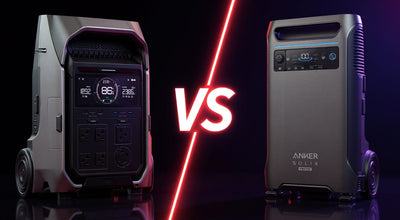
The EcoFlow DELTA Pro Ultra is the bigger system: 7,200W of output, 6,144Wh per battery, and room to grow to 90kWh. The Anker SOLIX F3800 Plus is the simpler buy: 6,000W and 3,840Wh in one rolling unit for much less money. Pick the DELTA Pro Ultra to back up a whole house with central air. Pick the F3800 Plus to cover essential circuits, a well pump, and the fridge.
Who This Guide Is For
- Homeowners pricing battery home backup power instead of a gas standby generator
- Buyers who need 240V for a well pump, dryer, or central AC during an outage
- Solar owners who want the fastest solar charging they can get
- Anyone stuck between the two biggest names in high-capacity power stations
What if the grid goes down for three days in July? That question splits these two machines. EcoFlow and Anker both build serious home backup, but they size the problem very differently.
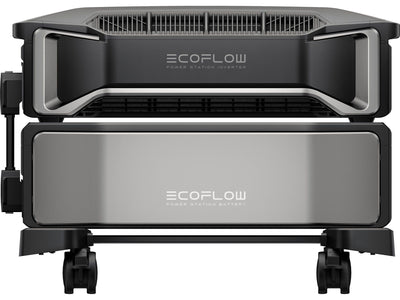
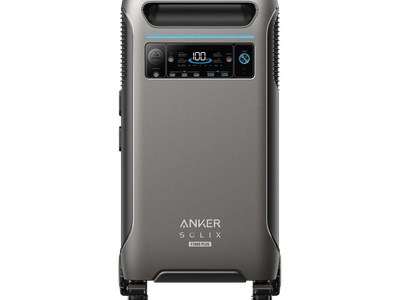
The Anker SOLIX F3800 Plus is a 3,840Wh portable power station on wheels. The EcoFlow DELTA Pro Ultra, often shortened to the Delta Ultra, is a modular home battery: an inverter and a battery stack that grows with you. Pair either one with panels and it works as one of the largest solar generators you can buy for an off-grid cabin or a grid-tied home. This guide compares the Anker SOLIX F3800 vs the EcoFlow DELTA Pro Ultra on output, battery capacity, solar input, and real-world runtime, using the manufacturers' own spec sheets [1][2].
How do the DELTA Pro Ultra specifications compare to the F3800 Plus?
Line up the Anker SOLIX F3800 and the EcoFlow DELTA Pro Ultra, and the DELTA Pro Ultra edges ahead on every power number, with 7,200W of continuous output against 6,000W and 6,144Wh of battery capacity against 3,840Wh [1][2]. The F3800 Plus leads on portability, because it is one 136.7 lb unit with wheels and a brake. Both deliver 120V and 240V, both use LFP batteries, and both carry a 5-year warranty.
| Spec | Anker SOLIX F3800 Plus | EcoFlow DELTA Pro Ultra |
|---|---|---|
| Battery capacity | 3,840Wh | 6,144Wh per battery |
| Continuous AC output | 6,000W | 7,200W per inverter |
| Voltage | 120V / 240V | 120V / 240V |
| Max solar input | 3,200W (2 x 11-165V) | 5,600W (4,000W high-V + 1,600W low-V) |
| Max storage | 26.9kWh per unit (53.8kWh linked) | 90kWh (3 inverters, 15 batteries) |
| Max linked output | 12,000W (2 units) | 21.6kW (3 inverters) |
| Battery / cycle rating | LFP, 3,000+ cycles to 80% | LFP, 3,500 cycles to 80% |
| UPS switchover | 20 ms | Under 20 ms |
| Weight | 136.7 lb, one unit on wheels | 70 lb inverter + battery over 110 lb |
| Warranty | 5 years | 5 years |
One note on the name. If you shopped the original Anker F3800, Anker has replaced it with the F3800 Plus. The battery and inverter are the same, but solar input jumped from 2,400W to 3,200W, and Anker added a generator input [1].
F3800 Plus vs DELTA Pro Ultra: which has more output power for 240V appliances?
One DELTA Pro Ultra inverter delivers 7,200W continuous and 10,800W surge at 120V and 240V [3]. That is 1,200W more continuous output power than the F3800 Plus at 6,000W. EcoFlow rates a single inverter to start a 3-ton central air conditioner [3].
The 6,000W F3800 Plus still handles most 240V loads that matter in an outage. A well pump, an electric dryer on a short cycle, or a mini-split all fit inside its continuous output rating. Its 240V output runs through a 30A L14-30R outlet, and a 30A TT-30R outlet serves an RV [1]. On a job site, it also runs corded power tools without the noise of a gas generator.
Both systems scale. Two linked F3800 Plus units reach 12,000W. Three DELTA Pro Ultra inverters reach 21.6kW, which is a real whole-home number [3].
| Decision factor | F3800 Plus | DELTA Pro Ultra |
|---|---|---|
| Output for 240V loads | ●●●●● | ●●●●● |
| Storage ceiling | ●●●●● | ●●●●● |
| Solar charging speed | ●●●●● | ●●●●● |
| Portability | ●●●●● | ●●●●● |
| Simple setup | ●●●●● | ●●●●● |
| Entry cost | ●●●●● | ●●●●● |
How much battery capacity and expandability do you get?
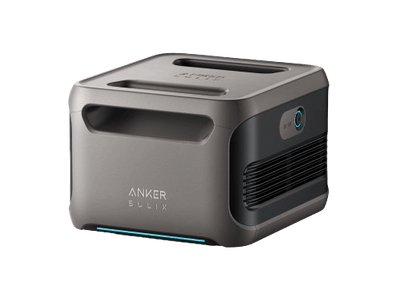
The DELTA Pro Ultra starts at 6,144Wh per battery and expands to 30kWh per inverter, or 90kWh across three inverters and 15 batteries [3]. The F3800 Plus starts at 3,840Wh and reaches 26.9kWh with six BP3800 expansion batteries, or 53.8kWh with two units linked [1].
Every watt-hour of extra AC power costs money, so for most homes the ceiling matters less than the starting point. Think of it like a fuel tank. A bigger tank is nice, but you only pay to fill the part you use.

Anker SOLIX BP3800 3840Wh LFP Expansion Battery for F3800 Station - Scalable Home Backup
$1,799.99
Shop NowHow long will each one run your home in a real-world outage?
At a 500W essentials load, the F3800 Plus runs about 6.5 hours and one DELTA Pro Ultra battery runs about 10 hours. Those figures assume about 85% of rated capacity reaches your appliances after inverter losses. Your numbers will move with the weather and with how often a compressor kicks on.
| Load (running watts) | F3800 Plus (~3,260Wh usable) | DELTA Pro Ultra, 1 battery (~5,220Wh usable) |
|---|---|---|
| Refrigerator, 150W average | about 21 hours | about 34 hours |
| Essentials: fridge, lights, Wi-Fi, phones, 500W | about 6.5 hours | about 10 hours |
| Well pump running, 1,000W | about 3 hours | about 5 hours |
| Central AC running, 3,500W | under 1 hour | about 1.5 hours |
Scenario: a three-day summer outage
A family runs the fridge, freezer, lights, Wi-Fi, and a window AC at night. That works out to about 6kWh a day. One DELTA Pro Ultra battery covers roughly the first day. The F3800 Plus covers about half a day. Add 2,000W of solar panels and either system can refill much of that by mid-afternoon, so the real limit becomes your roof, not the battery.
Plan for extended power outages before they happen. Keep a written list of what you must power, and never run a fuel generator indoors [4].
Which one recharges faster from solar, AC, or a generator?
In solar charging, the F3800 Plus vs EcoFlow DELTA Pro comparison is one-sided. The DELTA Pro Ultra accepts 5,600W of solar input, 2,400W more than the F3800 Plus at 3,200W [1][2]. EcoFlow splits that across a 4,000W high-voltage port and a 1,600W low-voltage port. Anker uses two 11V to 165V ports at 1,600W each.
Each extra solar panel you add shortens the time to fully charge, up to each unit's limit. From the wall, the F3800 Plus takes up to 1,800W of AC and can recharge in under 3 hours [1]. The DELTA Pro Ultra accepts 120V at 15A or 240V at 12.5A for faster rapid charging from a 240V circuit [2].
For long outages, generator charging matters most. The F3800 Plus accepts 6,000W from a gas generator through Anker's adapter once an expansion battery is attached, and refills in about 1.5 hours [1]. The DELTA Pro Ultra pairs with EcoFlow's dual-fuel Smart Generator [5].
Which one is easier to move and set up?

The F3800 Plus weighs 136.7 lb in a single unit with wheels and a brake [1]. The DELTA Pro Ultra splits into a 70 lb inverter and a separate battery that weighs over 110 lb [5]. So the Anker rolls into the garage in one trip, and the EcoFlow takes two.
For a quiet power source in the garage, either one beats a fuel generator: no fumes, no oil changes, and no fuel to store. The F3800 Plus even adds a 12V car socket for small DC gear.
That split is also the DELTA Pro Ultra's strength. It is built to live in one spot, wired into a home panel, and grow one battery at a time. Portability is not its job.
How do they connect to your home panel?

Both work as an uninterrupted power supply. They switch from grid power to battery in 20 ms or less when the grid drops, which is fast enough for most computers and Wi-Fi gear [1][3]. For whole-home backup, each pairs with its own panel: the Anker Home Power Panel or the EcoFlow Smart Home Panel 2.
Either route needs a licensed electrician to tie into house circuits. If you only need a few circuits, a manual transfer switch is the lower-cost path. We stock both in our transfer switch collection.
EcoFlow DELTA Pro Ultra: best for whole-home backup
As an EcoFlow power station, the DELTA Pro Ultra is a plug-and-play home system once the panel is in. Choose it if you want central air, a well pump, and the kitchen running at the same time. It has the most output, the most solar input, and the highest storage ceiling of any system here. The trade-off is a higher price tag and a two-piece setup.

EcoFlow DELTA Pro Ultra Home Battery System - 6kWh to 30kWh Expandable
$3,974.00
Shop NowWant the panel included? The DELTA Pro Ultra Home Standby Starter Bundle pairs the system with the Smart Home Panel 2.
Anker SOLIX F3800 Plus: best value for essential circuits
Between Anker and EcoFlow, this is the value pick. Choose the F3800 Plus if you want strong 240V backup for less money and a unit you can roll out to the RV or job site. It is the best portable pick in this class, and its 3,200W of solar input is a big step up from the original F3800.

Anker SOLIX F3800 Plus 3840Wh Expandable Power Station - 6000W Output LiFePO4
$2,399.99
Shop NowThe Bottom Line
In the Anker F3800 Plus vs EcoFlow DELTA Pro Ultra matchup, there is no single winner, only a better fit for your backup power needs. The EcoFlow Ultra is a home energy system. The Anker SOLIX F3800 Plus is a very large portable power station that can back up a home. If your power needs include central air or several 240V loads at once, buy the EcoFlow. If you need the fridge, well pump, and lights covered at a lower cost, buy the Anker.
Still weighing other options? See our guide to Powerwall alternatives, compare the Jackery vs Anker lineups, or browse every portable power station we carry.
Next Steps
- List every appliance you must run at once, and add up the running watts.
- Decide between essential circuits and whole-home backup.
- Check your solar plan against each unit's solar input limit.
- Price the panel or transfer switch, plus electrician time.
- Shop the F3800 Plus or the DELTA Pro Ultra, or contact us for help sizing your system.
Frequently Asked Questions
Is the EcoFlow DELTA Pro Ultra better than the Anker SOLIX F3800 Plus?
It depends on the size of the job. The DELTA Pro Ultra wins on raw numbers: 7,200W of output, 6,144Wh per battery, and up to 90kWh of storage. The F3800 Plus wins on price per watt-hour and on simplicity, since it is one rolling unit instead of an inverter plus a battery.
Which one is better for whole-home backup?
For a true whole-home setup, the DELTA Pro Ultra has more headroom. One inverter delivers 7,200W, and three linked inverters reach 21.6kW. The F3800 Plus covers most essential-circuit backup at 6,000W, and two linked units reach 12,000W.
Is the F3800 Plus the same as the original F3800?
No. The F3800 Plus keeps the same 3,840Wh battery and 6,000W inverter, but Anker raised solar input from 2,400W to 3,200W with two 165V solar ports. It also added a generator input port with a bypass function.
How does the DELTA Pro Ultra compare to the DELTA Pro 3?
They are different classes. The DELTA Pro 3 is a single 4,096Wh portable unit that EcoFlow has discontinued. The DELTA Pro Ultra is a modular home battery that starts at 6,144Wh and scales to 90kWh. We compare the DELTA Pro 3 head to head in our F3800 vs DELTA Pro 3 guide.
Can either one run central air conditioning?
EcoFlow rates one DELTA Pro Ultra inverter to run a 3-ton central air conditioner. The F3800 Plus can run smaller 240V loads like a well pump within its 6,000W limit. Always check the starting (LRA) current on your unit before you count on it.
Which recharges faster from solar?
The DELTA Pro Ultra takes up to 5,600W of solar input across a high-voltage and a low-voltage port. The F3800 Plus takes up to 3,200W through two 11V to 165V ports. More solar input means a faster refill on a sunny day.
Can I charge them with a gas generator?
Yes. The F3800 Plus accepts up to 6,000W from a generator through Anker's generator adapter when at least one expansion battery is connected. EcoFlow lists its Smart Generator as one of the DELTA Pro Ultra's charging options.
How long will each one run my house?
Divide usable watt-hours by your load in watts. With about 85% conversion efficiency, the F3800 Plus gives roughly 3,260Wh and one DELTA Pro Ultra battery gives roughly 5,220Wh. A 500W essentials load runs about 6.5 hours on the Anker and about 10 hours on the EcoFlow.
Which one is easier to move?
The F3800 Plus is one 136.7 lb unit with built-in wheels and a brake. The DELTA Pro Ultra splits into a 70 lb inverter and a separate battery that weighs over 110 lb, so you move two heavy pieces. EcoFlow sells an optional trolley.
What warranty do they come with?
Both brands list a 5-year warranty on these units. Both use LiFePO4 (LFP) batteries. Anker rates the F3800 Plus for 3,000+ cycles to 80% capacity, and EcoFlow rates the DELTA Pro Ultra battery for 3,500 cycles to 80%.
Do I need an electrician?
For a plug-in setup, no. To back up house circuits, you need a transfer switch or a home panel installed by a licensed electrician. Anker uses its Home Power Panel, and EcoFlow uses its Smart Home Panel 2.
References
- Anker SOLIX. "F3800 Plus Portable Power Station." ankersolix.com
- EcoFlow. "DELTA Pro Ultra." us.ecoflow.com
- EcoFlow. "DELTA Pro Ultra Starter Kit specifications." us.ecoflow.com
- Ready.gov (FEMA). "Power Outages." ready.gov
- EcoFlow. "DELTA Pro Ultra FAQ." ecoflow.com