

Last updated: April 17, 2026
Quick Answer
For most homeowners on natural gas, the Briggs & Stratton PP22 is the stronger long-term investment than a comparable Generac Guardian. It delivers a full 22kW on natural gas through NGMax technology and carries a 7-year comprehensive warranty that covers parts, labor, and travel [3]. The trade-off is dealer coverage, where Generac has the larger installer network in rural markets [4].
Who This Is For
- Homeowners comparing Generac and Briggs & Stratton standby generators before purchasing
- Families in storm-prone or outage-heavy areas who need reliable whole-home backup
- Buyers connected to natural gas who want full-rated output without switching to propane
- Anyone who wants a clear, spec-based comparison instead of brand loyalty talking points
What's the Difference Between Generac and Briggs & Stratton?
Generac was founded in 1959 and introduced the first affordable home standby generator in 1989 [4]. It holds the largest market share in residential backup power. The company builds generators, transfer switches, and monitoring hardware under one roof.
The Guardian series spans the air-cooled range from 10kW to 26kW. Its Evolution controller offers Wi-Fi monitoring through Generac's mobile app [4]. The dealer network is the largest in the industry, with thousands of authorized installers across the U.S.
Briggs & Stratton has built engines and outdoor power equipment since 1908 [3]. The PowerProtect line is newer to the standby market, but the engineering reflects over a century of engine manufacturing.
The company focused on fixing three specific pain points homeowners report: natural gas output loss, short warranty windows, and complicated installs [3]. The result is the PowerProtect series (PP13, PP22, PP26) with NGMax technology and a 7-year comprehensive warranty that covers parts, labor, and travel.
Both companies build reliable products. The differences show up in the details that shape your ownership experience over 10 to 20 years.

How Do the Specs Compare?
Briggs & Stratton leads on natural gas output, warranty, and noise. Generac leads on dealer coverage. The table below compares the PowerProtect lineup against the closest Guardian equivalents on the specs most homeowners weigh [3][4].
| Spec | B&S PP13 (13kW) | Generac Guardian 13kW | B&S PP22 (22kW) | Generac Guardian 22kW | B&S PP26 (26kW) | Generac Guardian 26kW |
|---|---|---|---|---|---|---|
| Output (NG) | 11.5 kW | ~11 kW | 22 kW (NGMax) | ~19.5 kW | 24 kW | ~22 kW |
| Output (LP) | 13 kW | 13 kW | 22 kW | 22 kW | 26 kW | 26 kW |
| Motor-Starting (kVA) | 37 kVA | ~37 kVA | 45 kVA | ~45 kVA | 65.5 kVA | ~55 kVA |
| Noise Level | 69 dB at 23 ft | ~67 dB | ~65 dB | ~67 dB | ~65 dB | ~67 dB |
| Cold Weather Rating | -20°F to 104°F | -22°F to 104°F | -20°F to 104°F | -22°F to 104°F | -20°F to 104°F | -22°F to 104°F |
| Warranty | 7-year comprehensive | 5-year limited | 7-year comprehensive | 5-year limited | 7-year comprehensive | 5-year limited |
| ATS Included | 200A ATS included | Varies by package | 200A ATS included | Varies by package | 200A ATS included | Varies by package |
| Installed Cost Range | $8,000–$11,000 | $8,000–$11,000 | $9,000–$14,000 | $9,000–$14,000 | $10,000–$15,000 | $10,000–$15,000 |
Decision Factor Scorecard
Not every buyer weights the same criteria. This scorecard summarizes how each brand performs across the six factors that matter most in a standby generator purchase.
| Factor | Briggs & Stratton | Generac | Why It Matters |
|---|---|---|---|
| Warranty Coverage | ●●●●● Excellent | ●●●○○ Good | 7-year comprehensive vs. 5-year limited (DX models extend to 10 years). Biggest financial differentiator over 15-year ownership. |
| Natural Gas Output | ●●●●● Excellent | ●●●○○ Good | PP22 delivers full 22kW on NG via NGMax. Generac 22kW drops to ~19.5kW on natural gas. |
| Noise Level | ●●●●○ Very Good | ●●●○○ Good | PP22/PP26 at ~65 dB vs. Guardian at ~67 dB. 2 dB difference is perceptible during overnight outages. |
| Dealer Network | ●●●○○ Good | ●●●●● Excellent | Generac has the largest dealer network in the U.S. B&S coverage is strong in metro areas, thinner in rural markets. |
| Smart Monitoring | ●●●●○ Very Good | ●●●●● Excellent | Generac Mobile Link app is a more mature platform with wider ecosystem. Both brands offer real-time status and alerts. |
| Long-Term Value | ●●●●● Excellent | ●●●○○ Good | Longer warranty + full NG output + lower noise adds up to a stronger 15-year investment for most homeowners. |
The installed cost ranges overlap because the generator itself is only part of the total. Permits, concrete pad, gas line extension, electrical panel work, and labor make up a large portion of the final bill. When the installed price is similar, the warranty and performance specs become the deciding factors.
How Do the Warranties Compare?
Briggs & Stratton offers a 7-year comprehensive warranty on the PP13 through PP26, compared to Generac's 5-year limited warranty [3][4]. Dealer-exclusive (DX) versions of the Briggs units extend coverage to 10 years when you buy through an authorized dealer [3].
Here's what that means in practice. Generac's 5-year Guardian warranty covers parts, labor, and travel in years one and two.
It drops to parts only in year three, and major components in years four and five [4]. After year two, labor and travel costs for service calls fall on the homeowner.
Briggs & Stratton takes a different approach. The 7-year comprehensive warranty covers parts, labor, and travel for the full term [3]. If a control board fails in year 6 of owning a PP22, a technician comes to your home, diagnoses the issue.
Replaces the part at no cost. No claim forms. No labor rates to negotiate.
Over a 15-year ownership period, the gap can represent $1,000 to $3,000 or more in potential service costs. That shifts the total cost of ownership toward the longer warranty, even when the upfront price is similar.
What the Warranty Gap Costs You Over 15 Years
Think of the warranty difference the way you think about a roof: you buy coverage for the years when things are most likely to go wrong. Generators reach their highest repair risk between years 5 and 12, as starters, voltage regulators, and control boards age. Here is what that gap looks like in dollars:
| Year Range | B&S PP22 (7-yr comprehensive) | Generac Guardian (5-yr limited) |
|---|---|---|
| Years 1–5 | Covered (parts + labor + travel) | Covered (parts; labor may vary) |
| Years 6–10 | Covered (parts + labor + travel) | Out-of-pocket ($0–$3,000+) |
| Typical repair cost (control board/starter) | $0 (warranty) | $400–$1,200+ parts + labor |
The upfront generator prices are similar. The warranty structure is where the long-term cost diverges.
Which Generator Is Quieter?
The Briggs & Stratton PP22 and PP26 run at roughly 65 dB at 23 feet [3]. That is about 2 dB quieter than Generac Guardian models at 67 dB [4]. The PP13 is the exception, running slightly louder at 69 dB.
Generator noise matters more than most buyers expect. Your unit will run for hours or days during an extended outage, and your neighbors will hear it too. Some municipalities set limits on outdoor equipment noise, especially at night.
A 2 dB difference is subtle but perceptible, especially during nighttime operation when ambient noise drops [6]. If your generator pad sits near a bedroom window or a neighbor's property line, the quieter unit will create fewer complaints over a multi-day outage.
Both brands use air-cooled engines, which produce more noise than liquid-cooled commercial units. If noise ranks high on your list, the PP22 or PP26 offers a small but real advantage over comparable Generac models.
How Do They Perform on Natural Gas?
The Briggs & Stratton PP22 delivers a full 22kW on natural gas through NGMax technology [3]. The Generac 22kW Guardian drops to roughly 19.5kW on natural gas, a 10 to 12% output penalty [4].
Most home standby generators connect to natural gas because the fuel supply never runs out. You don't schedule tank refills or worry about running dry during a long outage. But natural gas has lower energy density than propane.
Natural gas contains about 1,020 BTU per cubic foot compared to propane's 2,516 BTU per cubic foot [1]. That gap is why most generators produce less power on NG than on LP.
The Generac 22kW Guardian produces 22kW on propane but drops to roughly 19.5kW on natural gas [4]. For homes drawing close to 22kW with HVAC, a well pump. Kitchen appliances, you lose the headroom you paid for when you run on NG.
Briggs & Stratton solved this with NGMax on the PP22. The unit delivers a full 22kW on both natural gas and propane [3].
Zero output loss. For homeowners on a gas line, you get the capacity you paid for regardless of fuel type.
The PP13 produces 11.5kW on natural gas and 13kW on LP, a typical ratio for this size class. The PP26 produces 24kW on NG and 26kW on LP [3]. NGMax at the 22kW level is unique to Briggs & Stratton and solves a real problem for natural gas customers.
Which Brand Has Better Dealer Coverage?
Generac has the larger dealer network, with thousands of authorized installers across the U.S. [4]. Briggs & Stratton coverage is strong in metro markets but thinner in rural areas [3].
Most homeowners can find a local Generac installer within a short drive. That network often means shorter lead times for installation and more options for competitive quotes.
Briggs & Stratton authorized installers cover most metro areas and many suburban markets. In some rural areas, you may need an installer who travels a longer distance, which can affect scheduling.
If fast installation is your top priority before the next storm season, check dealer availability in your area for both brands. A generator with a 7-year comprehensive warranty and full natural gas output may still be worth the slightly longer wait. For a broader cross-brand view, see our Cummins vs Briggs & Stratton vs Generac vs Kohler comparison.
Which Generator Is Right for Your Home?
Choosing between Generac and Briggs & Stratton comes down to what matters most in your situation.
Scenario: February Ice Storm, Day 3
The power went out Tuesday night. It is now Friday morning. The temperature outside is 18°F. Your furnace is running. The refrigerator is on. Your sump pump is running intermittently. Your home draws roughly 18 to 20 kW under these conditions.
With a Generac 22kW on natural gas: your generator is producing ~19.5 kW. You have about 1.5 kW of headroom. If someone runs the microwave while the furnace cycles on, you are at the edge of capacity.
With a Briggs & Stratton PP22 on natural gas: your generator is producing a full 22 kW. You have 2 to 4 kW of usable headroom on the same fuel. The furnace, sump pump, and kitchen are all running without compromise.
That 2.5 kW difference is not theoretical. On a cold winter night at 18°F with a high-demand load, it is the difference between comfortable operation and tripped circuits.
If you're on natural gas and want full-rated power, the Briggs &. Stratton PP22 with NGMax gives you 22kW on natural gas without the output drop other brands accept as normal [3]. For homes that need every kilowatt to cover central air, a well pump, and a full kitchen, that difference matters during a July heat wave.
If long-term cost of ownership drives your decision, the warranty gap is hard to ignore. A 7-year comprehensive warranty covering labor and travel removes service-call risk during the first seven years [3].
DX models through authorized dealers extend that to a full decade. Generac's 5-year limited warranty leaves you exposed sooner [4].
If you need the fastest possible installation, Generac's larger dealer network may get you up and running sooner in some areas. Check local availability for both brands to compare lead times.
If you're covering a smaller home on a budget, the Briggs &. Stratton PP13 at $4,460 (before installation) delivers 13kW on LP with a 200A automatic transfer switch and a 7-year comprehensive warranty [3].
That's a strong value for homes under 2,500 square feet. For alternative backup options, see our home battery backup collection or our best portable power station for CPAP article if medical equipment is the priority.
For most homeowners, the combination of better warranty coverage, full natural gas output, and competitive installed pricing makes Briggs & Stratton the stronger long-term investment. You buy a generator hoping you won't need it often.
When you do, the unit with better specs and longer protection gives you more confidence. For sizing help, start with our generator size chart.
How Do the Smart Features Compare?
Generac's Mobile Link platform is the more mature system, with a larger connected ecosystem refined over several product generations [4]. Briggs & Stratton's monitoring covers the same core functions on the PP13, PP22, and PP26 with a simpler interface [3].
Both brands let you check generator status, receive outage alerts, and schedule exercise cycles from your phone. The goal is the same: confirm your home has backup power without walking outside to look at the unit.
Generac built its Evolution controller into the Guardian series. The controller has a color LCD on the unit and pairs with the Mobile Link Wi-Fi module [4].
From the app you can see whether the generator is running or in standby, review maintenance reminders. Get push notifications the moment utility power drops.
You can also schedule weekly self-tests, choosing a day and time that suits your household. If the generator detects a fault, the app flags it with an alert code. For homeowners with a second property, remote visibility matters.
Briggs & Stratton equips the PP13, PP22, and PP26 with a similar monitoring system [3]. The controller manages automatic weekly exercise, tracks run hours, and watches for fault codes. Remote connectivity pushes alerts when the generator activates and flags upcoming maintenance.
The practical difference comes down to polish. During normal weeks, the generator runs a short self-test once and the app confirms it completed. During an outage, both platforms notify you that the unit started.
Generac's app is more refined. Briggs & Stratton's covers the essentials without extra features.

What Generator Installation Involves
A standby generator install runs four to eight weeks from order to first automatic test [2][5]. The unit sits on a concrete or composite pad at least 5 feet from windows, doors. Fresh air intakes, with additional clearance required in many local codes [5].
Every install starts with site preparation. The pad needs clearance from gas meters, electrical panels, and property lines.
Your installer will evaluate the best location based on where your gas supply enters the property. They also factor in how far the unit sits from the automatic transfer switch, and how sound will affect your living spaces and neighbors [8].
Both Briggs & Stratton and Generac include a 200-amp ATS with their home standby models [3][4]. That eliminates the need to buy one separately.
The ATS mounts next to your main electrical panel and handles the automatic switchover when utility power drops. For a sizing reference, use our generator size chart.
Gas line sizing is one of the most important parts. Your existing gas line may not carry enough volume to feed a 22kW or 26kW generator plus your furnace, water heater, and stove. A qualified installer calculates the total BTU demand on your gas system and upsizes the supply line from the meter if needed [1].
Propane installations add tank placement and line routing. Most installers recommend a minimum 500-gallon propane tank for whole-home standby use, which provides several days of runtime depending on load. If you already have a smaller tank for a gas fireplace or pool heater, plan for an upgrade.
Most municipalities require electrical and gas permits, governed by NFPA 70, the National Electrical Code [2]. Some also require a separate building permit for the concrete pad.
Your installer typically files the permit applications, but approval can take one to four weeks depending on the local building department. You also need to notify your utility before the system is energized, since the transfer switch interacts with the grid [5].
Ask your installer about their permit timeline, who handles the gas line work, and whether the quoted price includes the concrete pad. For larger or commercial loads, see our commercial generator sizing guide.

How Much Fuel Does a 22kW Generator Use?
A 22kW air-cooled generator consumes roughly 2 to 3 gallons of propane per hour at 50% load. 3.5 to 4.5 gallons per hour at full load [3][4]. Natural gas installations pull about 200,000 to 250,000 BTU per hour at full output [1].
Runtime depends entirely on your fuel source. If your generator connects to a natural gas utility line, runtime is effectively unlimited.
The gas flows continuously from the municipal supply, so your generator runs as long as the gas utility stays operational [1]. That holds in the vast majority of power outages, since gas and electric infrastructure are separate systems.
That is the single biggest reason most homeowners with access to natural gas choose it for permanent standby installs. For a 20kW-class runtime reference, see our how long a 20kW standby generator runs breakdown.
Propane generators draw from a finite tank, so runtime depends on tank size and load. At 50% load, an air-cooled 22kW unit consumes about 2 to 3 gallons of propane per hour. At full load, that climbs to 3.5 to 4.5 gallons per hour.
A 500-gallon propane tank filled to its usable capacity gives you roughly five to eight days at half load. Or three to four days under heavier demand. These are approximate ranges that vary by model, altitude, and ambient temperature.
If your area sees multi-day outages from hurricanes or ice storms, 500 gallons is the minimum most installers recommend. A 1,000-gallon tank doubles your buffer and reduces the urgency of scheduling a propane delivery during a regional emergency.
Propane Runtime Estimates by Load (22kW Air-Cooled Generator)
Runtime depends on how hard the generator is working. The table below uses approximate consumption rates for an air-cooled 22kW unit at different load levels.
| Load Level | Approximate Consumption | 500-gal Tank Runtime | 1,000-gal Tank Runtime | Typical Use Case |
|---|---|---|---|---|
| 25% (~5.5 kW) | ~1.4 gal/hr | ~14 days | ~28 days | Lights, refrigerator, small electronics only |
| 50% (~11 kW) | ~2.4 gal/hr | ~8–9 days | ~17 days | Essentials + one HVAC zone, typical outage load |
| 75% (~16.5 kW) | ~3.5 gal/hr | ~5–6 days | ~11 days | Whole-home comfort: HVAC, kitchen, well pump active |
| 100% (~22 kW) | ~4.2 gal/hr | ~4–5 days | ~8–9 days | Full load: all zones, pool pump, heavy appliances |
Estimates based on a 400-gallon usable capacity for a 500-gallon tank (80% fill) and 800-gallon usable for a 1,000-gallon tank. Actual runtime varies by altitude, ambient temperature, and fuel quality. Consult your installer for a site-specific calculation.
For natural gas installations, the limiting factor is not supply volume but delivery pressure. Residential gas lines operate at low pressure, and your generator needs sufficient flow to produce its rated output. If the gas line feeding the generator is too small in diameter or covers too long a run, pressure can drop under load.
That reduces output and can trigger a fault. This is why gas line sizing during installation is so critical. Your installer will calculate the total BTU demand at full output.
Verify the existing supply can deliver it without starving your furnace or water heater. A 22kW natural gas generator consumes roughly 200,000 to 250,000 BTU per hour at full load. That is a significant draw on top of your other gas appliances.
The fuel choice also affects long-term engine health. Natural gas burns cleaner than propane, producing fewer carbon deposits in the combustion chamber and on spark plugs. Over a 15 to 20 year lifespan, this cleaner combustion can translate to lower maintenance costs and longer intervals between certain service tasks [9].
Propane still burns far cleaner than gasoline or diesel, so either fuel suits standby use well [7]. The deciding factor for most buyers is simply whether natural gas service is available at their property.
If it is, natural gas is the more convenient. Cost-effective choice for a generator that may sit idle for months between outages but needs to run for days when called on.
Calculate Your Home's Standby Power Needs
Use this calculator to estimate the generator size your home requires. Check the essential circuits you want backed up during an outage.
The calculator tallies running watts and startup surge, then recommends a generator size with headroom built in.
Essential Circuits
Select what you want running during a power outage
This calculator provides an estimate based on typical appliance wattages. For accurate sizing, consult a licensed electrician who can perform a full load calculation on your home.
What Maintenance Do These Generators Need?
Annual professional service is the core maintenance requirement for both brands. Plan on an oil change, spark plug inspection, battery load test.
Transfer switch check once a year, or every 200 hours of run time [3][4]. Most residential generators log far fewer than 200 hours a year, so the yearly schedule is what applies for most homeowners.
Consistent service is the single biggest factor in whether a generator lasts 10 years or 20. The good news: modern units handle much of their own upkeep through automated self-testing.
Both Briggs & Stratton and Generac run a brief exercise cycle once a week, typically 10 to 20 minutes [3][4]. The cycle circulates oil, charges the battery, and confirms all systems are working. It runs without any action from you and keeps the engine ready to start when an outage occurs.
The annual professional visit covers the deeper work. A certified technician performs an oil and filter change, air filter replacement, spark plug inspection, battery load test, and a thorough exercise run under load.
The technician also inspects the transfer switch contacts, checks for fault codes, and verifies the fuel system has no leaks. This visit typically runs $150 to $300 depending on region.
The warranty difference has a direct financial impact on maintenance years 6 through 10. The PP13, PP22, and PP26 all carry a 7-year comprehensive warranty covering parts, labor, and travel [3]. DX models extend that to 10 years through authorized dealers.
During those warranty years, if a component fails beyond normal wear, the manufacturer covers the repair and the technician's time. The Guardian series carries a 5-year limited warranty, so you start paying for parts and labor two years sooner [4]. Over 15 years, that gap can save hundreds to thousands as starters, voltage regulators, and control boards age.
10-Year Total Ownership Cost Comparison
The generator itself is only one line item. When you factor in maintenance, service, and the realistic repair costs that differ between a comprehensive and a limited warranty, the picture changes.
| Cost Category | B&S PP22 (22kW) | Generac Guardian (22kW) | Notes |
|---|---|---|---|
| Generator + ATS (unit price) | ~$6,037 | ~$5,700–$6,500 | Both include 200A ATS; prices vary by dealer |
| Installation (labor, permits, pad) | $3,000–$7,000 | $3,000–$7,000 | Nearly identical; depends on site complexity |
| Annual service (10 yrs at $200/yr) | ~$2,000 | ~$2,000 | Both brands require similar annual maintenance |
| Battery replacements (3× over 10 yrs) | ~$200 | ~$200 | 12V starter battery, roughly every 3–4 years |
| Out-of-warranty repairs (yrs 6–10) | $0 yrs 6-7 (warranty), potential cost yrs 8-10 | $0–$3,000+ (limited warranty expired yr 5) | Control boards, starters, voltage regulators are common yr 6–10 repairs |
| Estimated 10-Year Total | ~$11,200–$15,200 | ~$11,000–$18,700+ | B&S total cost is more predictable; Generac upper range depends on repair events |
Estimates only. Actual repair costs vary by region, dealer, and specific components that need service.
The 7-year comprehensive warranty on the PP22 and PP26 eliminates the repair cost variable during the first seven years of ownership. DX models extend this coverage to 10 years.
Beyond warranty coverage, year-over-year ownership cost is modest when you stay on schedule. Budget for the annual service visit, a battery replacement every three to four years (typically $50 to $100 for a 12V starter battery). Periodic spark plug replacements.
Homeowners who skip annual service are the ones who face expensive repairs down the road. A generator that gets its oil changed on time and runs its weekly test will be ready when the next storm hits. Whether that is next month or next decade.
Briggs & Stratton Models Worth Considering
13kW PowerProtect (PP13): Best for Homes Under 2,500 sq ft
The PP13 is the entry point into the PowerProtect line, and it delivers more than its price tag suggests. At 13kW on propane and 11.5kW on natural gas, it covers essential circuits and then some for mid-size homes.
The 37 kVA motor-starting capacity handles the surge when your AC compressor kicks on. The -20°F cold weather rating means it starts reliably in harsh winter conditions.
What sets the PP13 apart from competitors in this size class is the 7-year comprehensive warranty and the included 200A automatic transfer switch. Many competitors charge extra for the ATS or include a limited warranty that doesn't cover labor. At $4,460 before installation, the PP13 protects your home without overbuilding for circuits you don't need to back up.

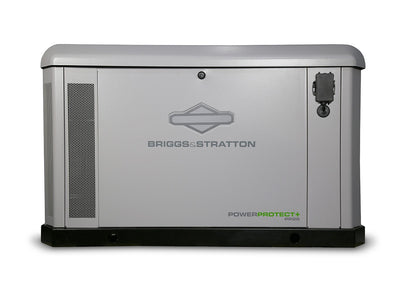
Briggs & Stratton 13kW PowerProtect Standby Generator
$4,535.00
Shop Now22kW PowerProtect (PP22): Full-Home Coverage with NGMax
The PP22 is the standout model in the PowerProtect lineup. NGMax technology delivers a full 22kW on both natural gas and propane.
It eliminates the output penalty every other air-cooled generator in this class accepts [3]. For homes with central air, electric cooking, a well pump, and multiple living zones, 22kW covers whole-home comfort.
The 45 kVA motor-starting capacity handles simultaneous startup of large appliances, and the 7-year comprehensive warranty covers parts, labor, and travel. DX models extend coverage to 10 years through authorized dealers.
At approximately 65 dB, it runs quieter than comparable Generac units. The PP22 at $6,037 represents the best balance of power, protection, and long-term value in the home standby category.

Briggs & Stratton PowerProtect+ 26kW Home Standby Generator
$7,195.00
Shop Now26kW PowerProtect (PP26): Maximum Output for Large Homes
The PP26 targets large homes with heavy electrical loads. At 26kW on propane and 24kW on natural gas, it handles homes over 3,500 square feet with multiple HVAC zones, pool equipment, or workshop circuits. The 65.5 kVA motor-starting capacity is the highest in the PowerProtect line, giving you headroom for demanding startup surges.
Like the PP22, the PP26 carries a 7-year comprehensive warranty and runs at approximately 65 dB. At $6,833 before installation, it costs less per kilowatt than many competitors at this output level. If your electrical panel audit shows loads above 22kW, the PP26 covers your home without compromise.
Briggs & Stratton PowerProtect+ 26kW Home Standby Generator
$7,195.00
Shop NowThese four PowerProtect models are the ones we stock and recommend most often, but the full lineup runs from 13kW to 26kW with single and dual transfer switch configurations. Compare every unit side by side in our Briggs & Stratton home standby generator collection.
The Bottom Line
Choosing between Generac and Briggs & Stratton comes down to four factors: warranty coverage, natural gas performance, noise levels, and installer availability. Briggs & Stratton leads on three of those four [3].
The PP22 and PP26 carry 7-year comprehensive warranties that cover parts, labor, and travel (extendable to 10 years on DX models). Generac's standard Guardian coverage is 5 years and limited [4].
The PP22's NGMax delivers a full 22kW on natural gas with zero output penalty. No other air-cooled generator in this class matches that spec [3]. At roughly 65 dB, the PP22 and PP26 run about 2 dB quieter than comparable Guardian models, a difference you notice during overnight outages.
Generac holds one clear advantage: installer availability. The Guardian network is the largest in the home standby market.
That often means shorter lead times in rural areas where Briggs & Stratton coverage is still growing [4]. In metro and suburban markets, both brands have strong coverage, so that edge narrows.
For homeowners running on natural gas, the PP22 wins on output, warranty, and noise. That is power that shows up when it counts.
Your next steps:
- Calculate your home's load using our generator size chart to find the right output range.
- Check local dealer availability for both brands within 30 miles of your home.
- Compare warranty terms side by side for the specific models you're considering.
- Get at least two installation quotes. Labor and gas line costs vary by region.
- Browse Briggs & Stratton models in our Briggs & Stratton home standby collection.
- Explore all home backup options in our home standby generators collection.
Pick the generator that protects your family on the worst night of the year, not just the one with the shortest install timeline.
Frequently Asked Questions
Questions about Generac vs Briggs & Stratton home standby generators, answered with specs and real-world context.
Is Briggs & Stratton better than Generac for home standby generators?
Both brands build reliable home standby generators. Briggs & Stratton offers longer warranty coverage (7 years comprehensive vs. 5 years limited, with DX models offering up to 10 years), full natural gas output on the PP22 through NGMax technology, and quieter operation on the 22kW and 26kW models. Generac offers a larger dealer network and a more mature remote monitoring app. For homeowners who prioritize long-term value and natural gas performance, Briggs & Stratton holds the edge on three of the four factors that matter most.
What are the pros and cons of Generac vs Briggs & Stratton?
Generac pros: largest dealer network in the industry, broadest product range from 10kW to 150kW+, proven Mobile Link Wi-Fi monitoring through the Evolution controller, and strong brand recognition among installers. Generac cons: 5-year limited warranty and a 10 to 12.5% natural gas output reduction on equivalent models.
Briggs & Stratton pros: 7-year comprehensive warranty covering parts, labor, and travel (up to 10 years on DX models), NGMax technology delivering full natural gas output on the PP22, and quieter operation at ~65 dB on the 22kW and 26kW models. Briggs & Stratton cons: smaller dealer network and a narrower product lineup focused on the 13kW to 26kW residential range.
What is the most reliable home standby generator?
Both Generac and Briggs & Stratton produce reliable home standby generators with strong field track records. Generac has the largest installed base in residential backup power and decades of reliability data across millions of units. Briggs & Stratton backs reliability with a 7-year comprehensive warranty covering parts, labor, and travel (up to 10 years on dealer-exclusive models). Reliability also depends on proper installation, site prep, and routine maintenance. An annual service by a certified technician keeps any standby generator performing at spec through its entire 15 to 20 year service life.
How do the warranties compare between Generac and Briggs & Stratton?
Generac's Guardian series comes with a 5-year limited warranty. Briggs & Stratton's PP13 includes a 7-year comprehensive warranty, and the PP22 and PP26 include a 7-year comprehensive warranty (extendable to 10 years on dealer-exclusive DX models). The key difference is in what "comprehensive" means: parts, labor, and travel costs are covered. Generac's limited warranty typically covers parts and may require the homeowner to cover labor or travel depending on the dealer agreement. That distinction becomes financially significant starting in year 6.
How much does it cost to install a Generac or Briggs & Stratton generator?
Installed costs for a 22kW home standby generator from either brand typically range from $9,000 to $14,000. This includes the generator, automatic transfer switch, concrete pad, gas line connection, electrical work, permits, and labor. The generator itself is typically $4,000 to $7,000 of that total. Both brands include a 200A ATS with their home standby models, which eliminates that as a separate line item. Costs vary significantly by region, gas line distance, and whether site prep requires excavation or panel upgrades.
How long do home standby generators last?
A well-maintained home standby generator typically lasts 15 to 20 years or more. Routine maintenance includes oil and filter changes, spark plug replacement, battery inspection, and annual professional service from a certified technician. Generators that run on natural gas tend to have longer engine life than propane units because natural gas burns cleaner, producing fewer combustion deposits. The single largest factor in longevity is staying on schedule with annual service, regardless of brand.
What is NGMax technology on Briggs & Stratton generators?
NGMax is Briggs & Stratton's engineering solution for the natural gas output penalty that affects most standby generators. Standard generators produce 10 to 15% less power on natural gas compared to propane because natural gas has lower energy density. The PP22 with NGMax delivers a full 22kW on natural gas, matching its propane output exactly. No other air-cooled generator in this class offers zero output loss on natural gas. For homes drawing close to 22kW under cold-weather or summer-peak conditions, that difference is the margin between adequate coverage and falling short.
Are Generac generators louder than Briggs & Stratton?
Generac Guardian models run at approximately 67 dB measured at a standard distance. The Briggs & Stratton PP22 and PP26 run at approximately 65 dB. The PP13 runs at 69 dB at 23 feet, which is slightly louder than Generac's equivalent. The 2 dB advantage on the 22kW and 26kW models is perceptible during nighttime operation when ambient noise drops. If your generator pad sits close to a bedroom window or property line, those 2 dB make a practical difference over a multi-day outage.
Can a home standby generator run on both natural gas and propane?
Yes. Both Generac and Briggs & Stratton home standby generators run on either natural gas or propane. The fuel type is configured during installation based on what is available at your home. Most urban and suburban homeowners choose natural gas for unlimited runtime, since the municipal gas supply remains operational in the vast majority of power outages. Propane is standard for rural properties without gas utility service. Once configured, switching fuels requires a carburetor or valve adjustment that should be done by a certified technician.
What size generator do I need for a 2,000-square-foot home?
Generator sizing for a 2,000-square-foot home typically points to a 13kW to 16kW unit. That covers central air, kitchen appliances, laundry, a sump pump, and standard lighting during a power outage. The Briggs & Stratton PP13 at 13kW on LP (11.5kW on NG) is sized for homes under 2,500 square feet and includes a 200A automatic transfer switch. If you want the entire house covered during a power outage or your home has a larger HVAC unit or well pump, step up to the PP22 for additional headroom. The best way to size accurately is a load calculation from your installer, who tallies your actual circuit demands.
Which generator is best for a large home over 3,000 square feet?
For homes over 3,000 square feet with multiple HVAC zones, a well pump, and heavy appliance loads, a 22kW or 26kW unit is recommended. The Briggs & Stratton PP22 covers most large homes at 22kW with full output on natural gas. The PP26 at 26kW handles the heaviest residential loads including pool pumps and workshop circuits. Both carry 7-year comprehensive warranties (up to 10 years on DX models). For homes above 3,500 square feet with unusual electrical demands, a load calculation is essential before selecting a size.
Does Generac have more dealers than Briggs & Stratton?
Yes. Generac has the largest dealer network in the home standby generator market with thousands of authorized installers nationwide. Briggs & Stratton's network is smaller but covers most metro areas. In some rural areas, a Briggs & Stratton installation may require a technician who travels a longer distance, which can affect scheduling timelines. If installation lead time is a priority for your situation, check local availability for both brands before deciding. In most metro and suburban markets, both brands have adequate coverage.
References
- U.S. Energy Information Administration. "Natural Gas Explained." eia.gov
- National Fire Protection Association. "NFPA 70 National Electrical Code." nfpa.org
- Briggs & Stratton Energy Solutions. "PowerProtect Home Standby Generator Specifications." energy.briggsandstratton.com
- Generac Power Systems. "Guardian Series Home Generator Specifications." generac.com
- National Fire Protection Association. "NFPA 37 Standard for the Installation and Use of Stationary Combustion Engines and Gas Turbines." nfpa.org
- U.S. Department of Energy. "Backup Power Systems for Homes." energy.gov
- U.S. Environmental Protection Agency. "Regulations for Emissions from Vehicles and Engines." epa.gov
- U.S. Consumer Product Safety Commission. "Portable Generator Safety." cpsc.gov
- National Renewable Energy Laboratory. "Backup Power Research and Resilience." nrel.gov