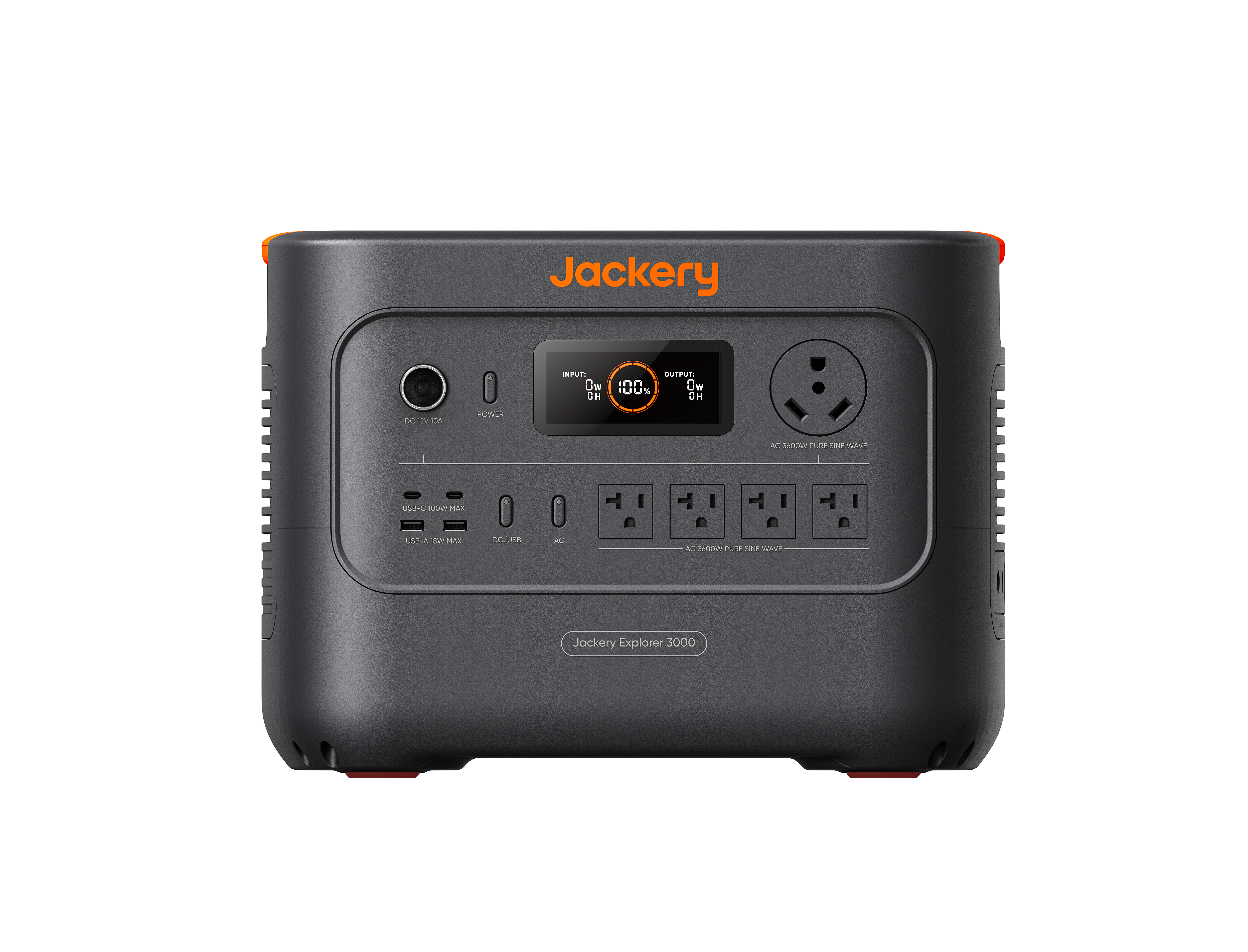
The Jackery HomePower 3000 is a 3,072Wh LiFePO4 home backup power station with 3,600W of continuous 120V output. Plug your refrigerator, internet and lights straight into it, or have an electrician connect it to a manual transfer switch so it can feed selected house circuits during an outage.
Plug-In Home Backup for Outages: Fridge, Internet and Lights Without a Gas Generator
The Jackery HomePower 3000 is a 3,072Wh lithium iron phosphate (LiFePO4) battery power station for home backup. It delivers 3,600W continuous and up to 7,200W surge at 120V from four 20A outlets and one 30A outlet, switches to battery in about 20 milliseconds when grid power drops, and recharges from a wall outlet in about 2.2 hours (about 1.7 hours with wall and solar together). Jackery estimates it keeps a 200W refrigerator running for one to two days. It weighs about 59.5 lb, needs no installation for plug-in use, and is offered here on its own or paired with two SolarSaga 200W panels or one SolarSaga 500 X panel.
-
3,072Wh LiFePO4 capacity
-
3,600W continuous output (7,200W surge peak)
-
~20ms switchover when grid power drops
-
2.2 hrs wall recharge (1.7 hrs wall + solar)
-
59.5 lb approximate weight
Built for the outage you know is coming
If you live where storms, ice or wildfire shutoffs take the power out every year, you already know the routine: food in the fridge starts the clock, the internet goes down, and a gas generator means fuel cans, an extension cord through a window and an engine running outside.
The HomePower 3000 replaces that routine for the loads that matter most. It sits in a kitchen or utility room, stays plugged into the wall, and holds about 95% of its charge after 12 months in storage thanks to Jackery's ZeroDrain technology. When the grid drops, it takes over in roughly 20 milliseconds, so a router, computer or smart home hub stays on without a reboot.
With 3,072Wh on board and 3,600W of output, it runs a refrigerator, freezer, Wi-Fi, fans, a TV and lights at the same time, with room left for a microwave or coffee maker in short bursts. When the outage ends, it refills from the wall in about 2.2 hours, or faster with solar panels connected as well, so it is ready for the next storm.
Key features
3,600W at 120V, 7,200W surge peak
Four 120V 20A outlets and one 120V 30A outlet share 3,600W continuous, with a 7,200W surge peak for motor starts such as a refrigerator compressor.
About 20ms switchover
Leave your essentials plugged in. When utility power cuts out, the HomePower 3000 switches to battery in about 20 milliseconds, which keeps everyday electronics online.
Fast recharge between storms
About 2.2 hours from a standard wall outlet at up to 1,800W, or as fast as 1.7 hours combining wall and solar charging (2,500W). It also charges from solar panels alone, a car outlet or a gas generator.
Ready after months on standby
ZeroDrain technology retains about 95% of the charge after 12 months on the shelf, so a unit kept for emergencies is ready when you need it.
Circuit backup when you want it
Use it plug-and-play today. Later, an electrician can install a manual transfer switch so the unit feeds up to six essential home circuits, according to Jackery.
LiFePO4 cells rated for 4,000 cycles
Lithium iron phosphate chemistry with Jackery's ChargeShield 2.0 battery protection, rated for 4,000 cycles to 70% or more of original capacity.
How long will it run?
| Load |
Estimate |
Assumption |
| Refrigerator (200W) |
1 to 2 days |
Jackery's published estimate |
| Box fan (50W) |
About 60 hrs |
Jackery's published estimate |
| LCD TV (60W) |
About 30 hrs |
Jackery's published estimate |
| Wi-Fi router (10W) |
About 66 hrs |
Jackery's published estimate |
| Coffee maker (1,120W) |
About 2 hrs |
Jackery's published estimate, continuous use |
All runtimes are approximate. They come from Jackery's own runtime estimates for a single appliance at the stated wattage on a full charge. Running several appliances at once divides the time between them, and temperature, battery age and how often a compressor cycles will change the result.
What can it power?
| Appliance |
Supported |
Notes |
| Refrigerator or chest freezer |
Yes |
Compressor starts are covered by the 7,200W surge peak |
| Wi-Fi router, modem, laptop |
Yes |
Low draw; stays online through the roughly 20ms switchover |
| Microwave, coffee maker, electric kettle |
Yes |
Within 3,600W; high draw, so use in short bursts |
| Window air conditioner |
Usually |
Check the unit's running and starting watts against 3,600W / 7,200W |
| 240V appliances (well pump, electric dryer, central AC) |
No |
Output is 120V only |
| Electric range or water heater |
No |
240V and too high a draw for this unit |
Is it right for you?
Best for
- Homeowners in outage-prone areas who want backup for the fridge, internet and lights without fuel
- Renters and condo owners who cannot install a standby generator
- Remote workers who need the router and computer to stay up when the grid drops
- Households that want to start plug-and-play and add a transfer switch later
- Buyers who want to recharge from solar panels during a long outage
Not the right fit for
- Running 240V loads such as a well pump, electric dryer or central air conditioning
- Whole-house backup of every circuit at once
- Medical or life-support equipment, which Jackery does not recommend powering from its power stations
- Carrying by hand over long distances: at about 59.5 lb it is a move-it-occasionally unit
Jackery HomePower 3000 vs. portable gas generator
|
Jackery HomePower 3000 |
Portable gas generator |
| Fuel |
None: recharges from the wall, solar, a car outlet or a generator |
Gasoline that must be bought, stored and refilled |
| Where it runs |
Indoors; no exhaust or carbon monoxide |
Outdoors only, away from doors and windows |
| When the power drops |
Switches over in about 20ms with loads plugged in |
Someone has to start it and run cords |
| Upkeep |
Keep it plugged in; holds about 95% charge after 12 months |
Oil changes, fuel stabilizer, periodic test runs |
| Run time |
As long as the 3,072Wh battery lasts, then recharge |
As long as fuel lasts |
Safety and setup
LiFePO4 chemistry and ChargeShield 2.0
Lithium iron phosphate cells are known for thermal stability and long life. Jackery adds its ChargeShield 2.0 battery management for charging protection.
Zero emissions indoors
There is no engine, so there is no exhaust or carbon monoxide. That is why it can sit in a kitchen, closet or utility room.
Transfer switch installation
Connecting any power station to house wiring requires a manual transfer switch installed by a licensed electrician, who will confirm it suits your panel and local code. Never backfeed a home through an outlet.
Temperature limits
Jackery rates charging from 32 to 113°F and discharging from 5 to 113°F, with output limited to 2,000W between 5 and 14°F. Keep it out of unheated spaces in deep cold.
Specifications
| Spec |
Value |
| Capacity |
3,072Wh (60Ah / 51.2V) |
| Battery chemistry |
LiFePO4 |
| Cycle life |
4,000 cycles to 70%+ capacity |
| AC output |
3,600W continuous, 7,200W surge peak, 120V 60Hz |
| AC outlets |
4 x 120V 20A (2,400W), 1 x 120V 30A (3,600W) |
| USB-C |
2 x 100W max |
| USB-A |
2 x 18W max |
| Car outlet |
12V, 10A max |
| Switchover (UPS) |
About 20ms |
| Bypass mode |
120V, 12A max, 1,440W |
| AC charging |
Up to 1,800W; about 2.2 hours |
| Wall + solar charging |
About 1.7 hours (2,500W combined) |
| Solar input |
2 x DC8mm, 1,000W max combined (16 to 60V) |
| Standby retention |
About 95% after 12 months (ZeroDrain) |
| Weight |
About 59.5 lb (27 kg) |
| Dimensions |
16.4 x 12.8 x 12 in |
| Charge / discharge temperature |
32 to 113°F / 5 to 113°F |
| Configurations on this listing |
HomePower 3000; with SolarSaga 200W x 2; with SolarSaga 500 X |
Frequently asked questions
How long will the Jackery HomePower 3000 run a refrigerator?
Jackery estimates one to two days for a refrigerator drawing about 200W on a full charge. A newer, efficient refrigerator that averages less will run longer; adding other loads shortens it.
Does the HomePower 3000 switch on automatically when the power goes out?
Yes, for devices plugged into it. With wall power connected, it switches loads to battery in about 20 milliseconds when grid power drops, which keeps everyday electronics like a router or computer running.
Can the HomePower 3000 power house circuits?
Yes, with a manual transfer switch installed by a licensed electrician. Jackery says it can then supply up to six essential home circuits. Without a switch, plug appliances directly into the unit.
Can it run a well pump or central air conditioner?
No. Its outputs are 120V only, and well pumps, electric dryers and central air conditioners usually need 240V.
How long does it take to recharge?
About 2.2 hours from a standard wall outlet, or about 1.7 hours using the wall and solar panels together. It accepts up to 1,000W of solar through two DC8mm inputs, and also charges from a car outlet or a gas generator.
Is it safe to use indoors?
Yes. It has no engine and produces no exhaust or carbon monoxide, so it can run inside the home. Keep it within its rated temperature range and away from water.
Can I use it for a CPAP or other medical device?
Jackery states that its portable power stations are not recommended for medical devices, life-support equipment or anything where an interruption could cause harm. Ask your device provider about a backup plan approved for your equipment.
Which version should I choose?
Choose the HomePower 3000 alone if you only need to ride out outages with wall recharging. Choose a solar pairing (two SolarSaga 200W panels or one SolarSaga 500 X) if outages in your area can last more than a day or two and you want to recharge without grid power.