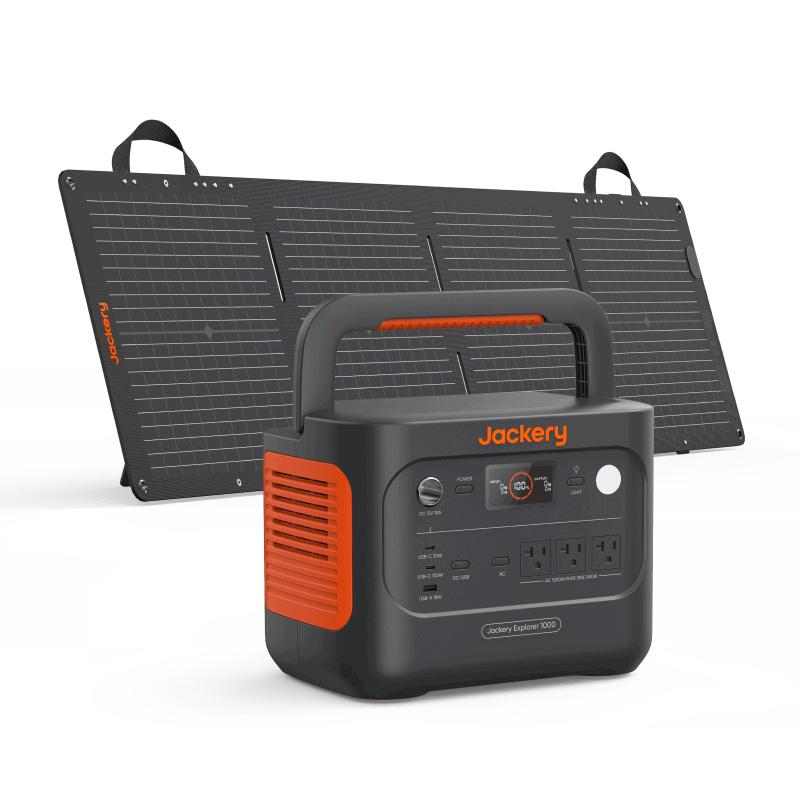
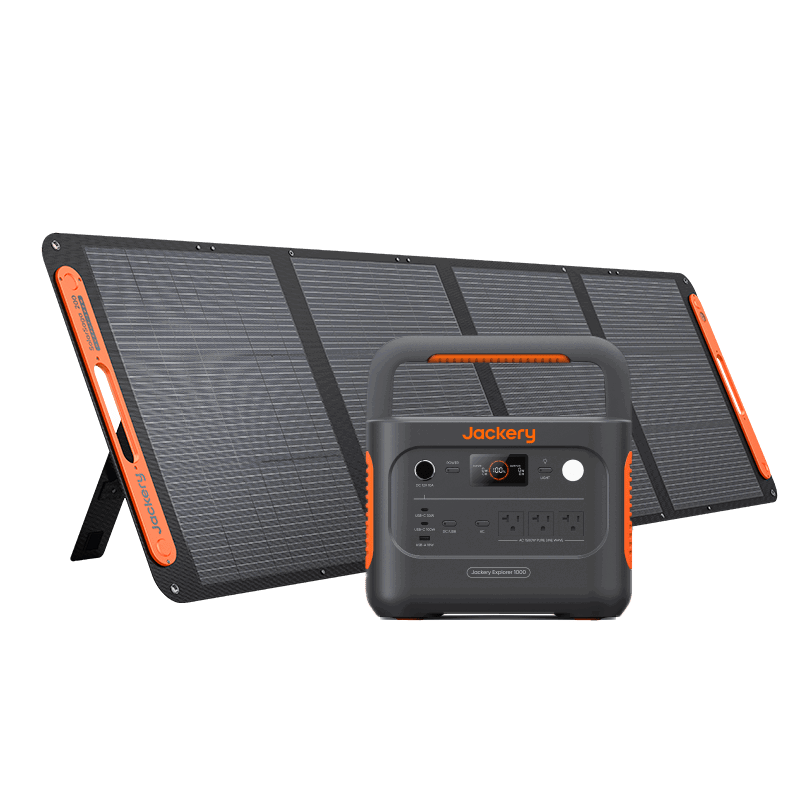
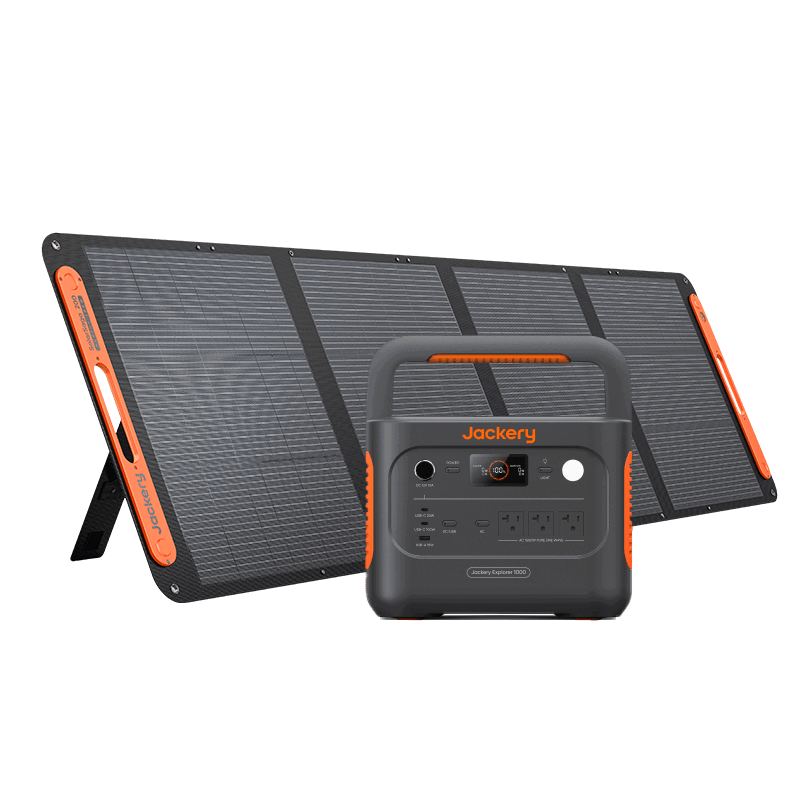
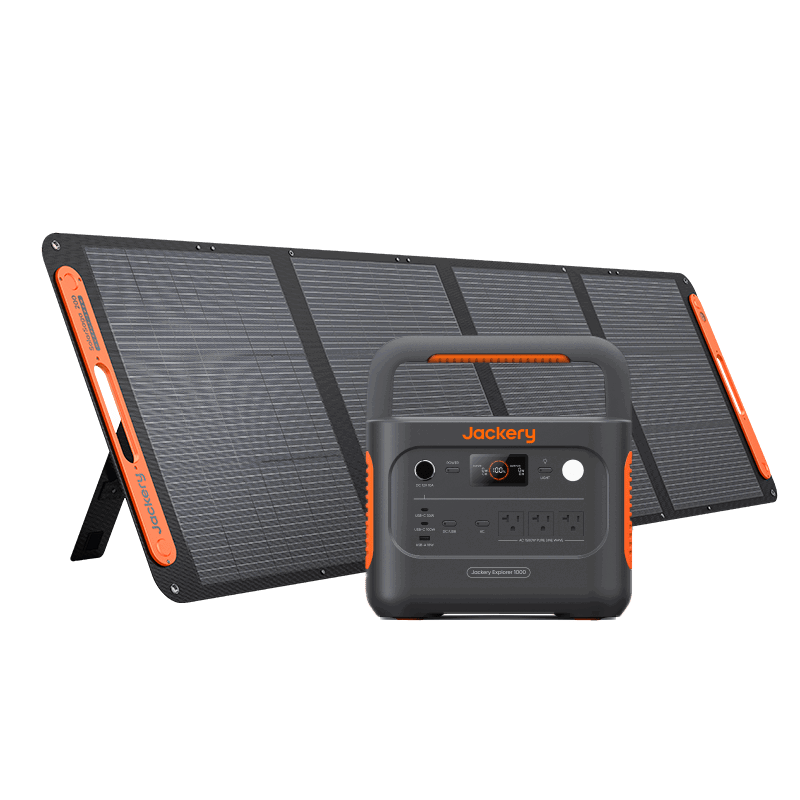
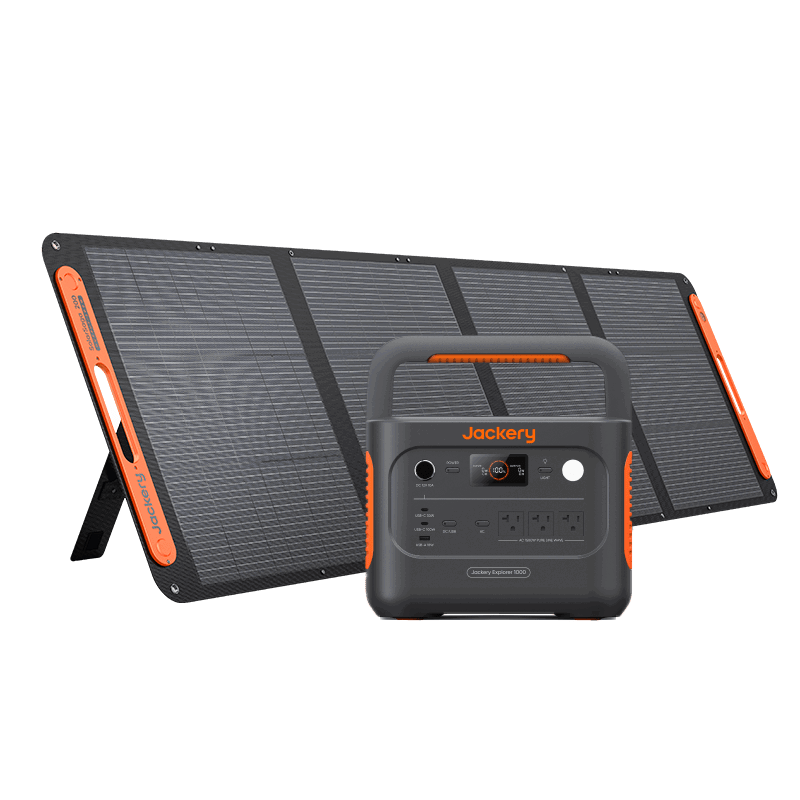
The Jackery Solar Generator 1000 V2 200W pairs the Explorer 1000 v2 portable power station (1,070Wh LiFePO4, 1,500W) with one SolarSaga 200W bifacial folding solar panel. It is a ready-to-use way to make your own power at a campsite, in an RV or van, or at home when an outage runs longer than a day.
A Portable Solar Generator That Keeps Recharging When the Grid Cannot
The Jackery Solar Generator 1000 V2 200W is a solar generator kit made of the Explorer 1000 v2 power station and one SolarSaga 200W folding solar panel. The station stores 1,070Wh in LiFePO4 cells rated for 4,000 cycles to 70% capacity and delivers 1,500W continuous (3,000W surge peak) from three 120V outlets, two USB-C ports, a USB-A port and a 12V car outlet. The bifacial panel is rated 200W (up to 225W with light reaching its back side) and IP68 water resistant. With strong sun, one panel refills the station in roughly 7 to 8 hours; a wall outlet does it in about 1.6 hours. The station weighs about 23.8 lb and the panel about 14.3 lb.
-
1,070Wh LiFePO4 battery
-
1,500W continuous AC (3,000W surge peak)
-
200W bifacial SolarSaga panel (up to 225W)
-
400W max solar input, room for a second panel
-
IP68 panel water and dust rating
Why add a panel instead of just a battery
A battery on its own is a countdown. Once a 1kWh station is empty during a three-day outage or a week off-grid, you are done until you find an outlet. Adding the SolarSaga 200W panel turns that countdown into a daily cycle: use power in the evening, refill during the day.
In good sun the 200W panel puts back a large share of the battery each day, enough to keep a 12V cooler, phones, lights and a fan going on a camping trip, or a refrigerator's worth of daytime top-up during an outage. Because the panel is bifacial, light reflecting off sand, snow or a light-colored surface adds output from the back side.
The station accepts up to 400W of solar, so you can add a second SolarSaga 200W later and roughly halve the charge time. When you are near an outlet, the wall still does it in about 1.6 hours.
Key features
Explorer 1000 v2: 1,070Wh, 1,500W
Three 120V AC outlets with 1,500W rated and 3,000W surge peak output, plus USB-C 100W and 30W, USB-A and a 12V car outlet.
SolarSaga 200W bifacial panel
Rated 200W at standard test conditions and up to 225W with rear-side light, IP68 water and dust resistance, and it folds to 23.6 x 23.5 x 1.6 in.
Room to grow to 400W of solar
Two DC8mm inputs take up to 400W combined, so a second SolarSaga 200W can be added for faster solar charging.
Fast wall charging
About 1.58 hours from a standard wall outlet, with an Emergency Super Charge mode for faster charging before a storm.
Quiet and fume-free
About 30dB in operation with no exhaust, so the station can run inside a tent, RV or home while the panel works outside.
Under 20ms switchover
Plugged into the wall at home, it switches to battery in under 20 milliseconds when the grid drops.
How long will it run?
| Load |
Estimate |
Assumption |
| 12V compressor cooler (45W avg) |
About 20 hrs |
From a full charge; about 900Wh usable assumed |
| Mini fridge (60W avg) |
About 15 hrs |
Same assumption |
| Box fan (40W) |
About 22 hrs |
Same assumption |
| Solar refill, one 200W panel |
About 7 to 8 hrs |
Strong direct sun; Jackery lists 7.5 hours |
Runtimes are approximate: a full charge, one device at the stated average wattage, and about 900Wh usable from the 1,070Wh battery after inverter losses. Solar charging depends on season, latitude, panel angle, heat and shade; cloudy days can produce a fraction of the rated output.
What can it power?
| Appliance |
Supported |
Notes |
| 12V cooler, mini fridge |
Yes |
Pair with daily solar to run it through a multi-day trip |
| Phones, laptops, cameras, drones |
Yes |
USB-C 100W charges most laptops directly |
| LED lights, fans, Wi-Fi router |
Yes |
Low draw; can often run around the clock with good sun |
| Coffee maker, kettle, small microwave |
Yes, if 1,500W or less |
High draw; short runtimes |
| Full-size refrigerator during an outage |
Yes, for hours |
Check its running watts; solar adds daytime top-ups |
| Space heater over 1,500W, RV rooftop AC, 240V loads |
No |
Beyond the 1,500W, 120V rating or the battery size |
Is it right for you?
Best for
- Campers and overlanders who want to stay out longer than one battery charge
- RV and van travelers boondocking without hookups
- Households in outage-prone areas that want a recharge source if the grid stays down for days
- Renters who need backup power and cannot run a gas generator
- Buyers who want a matched panel and station from one brand instead of piecing a system together
Not the right fit for
- Whole-home backup or 240V appliances
- Running high-draw loads all day from solar alone
- Shaded sites where the panel cannot see direct sun
- Medical or life-support equipment, which Jackery does not recommend powering from its power stations
Solar Generator 1000 V2 200W vs. battery-only setup
|
Solar Generator 1000 V2 200W |
Battery-only setup |
| Recharge without an outlet |
Yes, about 7 to 8 hours of strong sun per full charge |
Only from a car outlet (about 12 hours) or a generator |
| Multi-day outages and trips |
Refills each sunny day |
Ends when the battery is empty |
| Battery and output |
1,070Wh, 1,500W |
1,070Wh, 1,500W |
| Extra gear to carry |
About 14.3 lb folding panel |
None |
Safety and setup
LiFePO4 chemistry
Lithium iron phosphate cells with Jackery's ChargeShield 2.0 protection are known for thermal stability and long life.
Panel outside, station inside
The panel is IP68 rated, but keep the station dry and shaded. Run the solar cable through a door or window gap rather than leaving the station in rain or direct summer sun.
Temperature limits
Jackery rates the station for charging at 32 to 113°F and discharging at 14 to 113°F. The panel operates from -4 to 149°F.
Do not mix panels
Jackery does not recommend mixing different panel models, and more than two panels need its Solar Panel Connector.
Specifications
| Spec |
Value |
| Station |
Jackery Explorer 1000 v2 |
| Station capacity |
1,070Wh (30.4Ah / 35.2V), LiFePO4 |
| Cycle life |
4,000 cycles to 70%+ capacity |
| AC output |
3 x 120V 60Hz; 1,500W rated, 3,000W surge peak |
| USB / DC outputs |
USB-C 100W + 30W, USB-A 18W, 12V 10A car outlet |
| Switchover (UPS) |
Under 20ms |
| Solar input |
2 x DC8mm, 400W max combined (16 to 60V) |
| Charge times |
Wall about 1.58 hrs; car about 12 hrs; solar about 7.5 hrs per Jackery |
| Station weight / size |
About 23.8 lb; 12.87 x 8.82 x 9.72 in |
| Panel |
Jackery SolarSaga 200W, bifacial |
| Panel power |
200W (STC); up to 225W bifacial (BNPI) |
| Panel electrical |
Voc 22V, Isc 12.5A, Vmp 18V, Imp 11.5A |
| Panel water resistance |
IP68 |
| Panel weight |
About 14.3 lb |
| Panel size |
Folded 23.62 x 23.50 x 1.57 in; unfolded 89.76 x 23.50 x 0.98 in |
Frequently asked questions
What is in the Jackery Solar Generator 1000 V2 200W kit?
The kit is the Jackery Explorer 1000 v2 portable power station paired with one SolarSaga 200W bifacial solar panel. Check the packing slip for the cables and accessories that ship with your order.
How long does the 200W panel take to charge the Explorer 1000 v2?
Jackery lists about 7.5 hours of solar charging. In practice expect roughly 7 to 8 hours of strong, direct sun, and longer in winter, clouds or partial shade.
Can I add a second solar panel?
Yes. The Explorer 1000 v2 accepts up to 400W of solar through two DC8mm inputs, so a second SolarSaga 200W fits. Jackery does not recommend mixing panel models.
How long will it run a refrigerator during a power outage?
A full-size refrigerator averaging about 100 to 150W runs roughly 6 to 9 hours on a full charge, assuming about 900Wh usable. Daytime solar charging stretches that across a multi-day outage.
Is the Explorer 1000 v2 1,024Wh or 1,070Wh?
Jackery's US specification table for the Explorer 1000 v2 lists 1,070Wh (30.4Ah at 35.2V), so that is the figure used on this page.
Can I use the solar generator indoors?
The power station, yes: it has no engine and makes no exhaust. The panel goes outside in the sun, with its cable run to the station.
Can I use it for a CPAP machine?
Jackery states that its portable power stations are not recommended for medical devices, life-support equipment or anything where an interruption could cause harm. Ask your equipment provider about an approved backup plan.