

Quick Answer
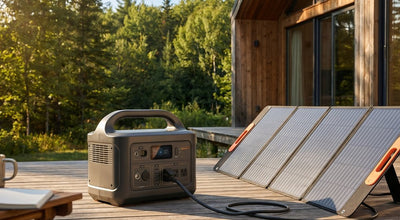
The Jackery Explorer 1000 V2 is the best all-around pick for most households, 1,070Wh of LiFePO4 capacity, a 1,500W AC output, and a genuine one-hour wall charge make it a serious emergency and outdoor power station at $429 [1]. If you need more muscle, the Explorer 3000 V2 jumps to 3,072Wh and 3,600W for $1,159, enough to run a full-size refrigerator for over 16 hours. Both use Jackery's upgraded ChargeShield 2.0 battery management system, which stretches the rated lifespan to 4,000 cycles [2].
Last Updated: April 2025 | Verified specs from Jackery.com and independent lab reviews
- Homeowners who want a portable power station for outage backup and need to know which V2 to buy
- Campers and RV users comparing Jackery V2 models against EcoFlow and Anker options
- CPAP users, van lifers, and off-grid cabin owners who need reliable LiFePO4 battery power
- Anyone upgrading from a first-generation Jackery Explorer and wondering what actually changed
What Actually Changed from V1 to V2?
The V1 Jackery Explorer 1000 used a lithium NMC battery, decent performance, but it degraded noticeably after 500 cycles. The V2 lineup switched to lithium iron phosphate (LiFePO4) chemistry across the board [3]. That change alone is significant. LiFePO4 cells are thermally stable, less prone to runaway, and deliver far more charge cycles before capacity degrades.
Jackery also rebuilt the battery management system into what they call ChargeShield 2.0. It monitors 62 individual safety parameters, compared to 32 in the first generation [2]. In plain terms, that means smarter charging that protects the cells from the heat spikes that shorten battery life.
The third major change is charge speed. The Explorer 1000 V2 wall-charges to 100% in one hour [1]. The original Explorer 1000 took around 1.8 hours on AC. That matters when grid power returns after an outage and you want a full charge before the next storm.
Which Jackery V2 Model Is Right for You?
Three models carry the "V2" badge at Mighty Generators. Here is how they compare across the factors that matter most for homeowners, campers, and off-grid users.
| Factor | E600v2 (640Wh) | E1000v2 (1070Wh) | E3000v2 (3072Wh) |
|---|---|---|---|
| Capacity | ●●○○○ | ●●●○○ | ●●●●● |
| AC Output Power | ●●○○○ | ●●●○○ | ●●●●● |
| Solar Charging Speed | ●●●○○ | ●●●●○ | ●●●●● |
| Portability | ●●●●● | ●●●●○ | ●●○○○ |
| Price Value | ●●●○○ | ●●●●● | ●●●●○ |
| Best For | Day trips, van life, CPAP | Home backup, camping, RV | Extended outages, job site, cabin |
Explorer 600 V2 (E600v2): The Lightweight That Does Heavy Lifting
At 640Wh and 16.1 lbs, the E600v2 is the pack-and-go option in the V2 lineup. It delivers 500W of AC output, enough to run a CPAP machine, charge laptops, and power an LED worklight simultaneously. The LiFePO4 upgrade gives it the same 4,000-cycle rating as its bigger siblings.
The standout feature is the 30% upgraded solar input. Pair it with a SolarSaga 200W panel and you can reach 80% charge in about 3.5 hours of peak sun. That makes it a real candidate for remote cabin use, not only for weekend camping.
Picture This:
Hurricane warning hits Friday afternoon. You grab the E600v2 from the shelf, plug it in, and have a full charge in under two hours. Come Saturday morning, your CPAP runs all night, your phone stays charged, and you keep a fan moving the whole time, all without touching a drop of gasoline.

Explorer 1000 V2: The One Most Households Need
The Amazon listing says it all: "1070Wh LiFePO4 Battery, 1500W AC/100W USB-C Output, 1 Hr Fast Charge." [1] Those three specs, capacity, output, and charge time, land the E1000v2 squarely in the sweet spot for most homeowners.
The 1,500W continuous AC output covers the appliances that matter in an outage. A 150W refrigerator runs for roughly 5.5 hours before you need a recharge. A 50W CPAP with humidifier runs through a full 8-hour night with battery capacity to spare. A 100W television runs 8+ hours for an extended movie marathon at the campsite [4].
What makes the E1000v2 exceptional at its price point is the Emergency Charging Mode. When grid power returns, you can accept charge at the maximum safe rate, filling from 0% to 100% in one hour. That is critical when power flickers back on during a storm and you want every watt stored before it drops again.
| Appliance | Typical Draw | E600v2 (640Wh) | E1000v2 (1070Wh) | E3000v2 (3072Wh) |
|---|---|---|---|---|
| Mini fridge (80W) | 80W avg | ~5.5 hrs | ~9 hrs | ~26 hrs |
| Full-size fridge (150W avg) | 150W avg | ~2.9 hrs | ~4.8 hrs | ~13.7 hrs |
| CPAP (no heat, ~30W) | 30W | ~14 hrs | ~24 hrs | ~68 hrs |
| 55" LED TV (100W) | 100W | ~4.3 hrs | ~7.2 hrs | ~20.5 hrs |
| Laptop (45W) | 45W | ~9.5 hrs | ~16 hrs | ~45 hrs |
| Circular saw (1,200W) | 1,200W | Not rated* | ~35 min | ~1.7 hrs |
| Microwave (1,000W) | 1,000W | Not rated* | ~42 min | ~2 hrs |
*E600v2 500W AC output. Runtimes assume 85% inverter efficiency and are estimates. Real results vary by appliance model and usage pattern.

1,500W AC output, one-hour wall charge, Emergency Charging Mode, 4,000-cycle LiFePO4 battery. The benchmark for home backup and camping power at $429.
Shop NowExplorer 3000 V2: When You Need Days, Not Hours
The Shopify product title is explicit: "3072Wh 3600W." That 3,600W continuous output is the key differentiator. Most portable power stations top out at 1,800W to 2,000W. The E3000v2 can run a full-size window air conditioner (around 1,200W), a chest freezer, and a phone charger, at the same time.
The E3000v2 supports 3000W of high-demand output, matching the draw of power tools and HVAC units. AC charging via wall outlet fills it in 1.8 hours. For solar users, the SolarSaga 500 X panel delivers the fastest off-grid recharge on the E3000v2.
At $1,159, it undercuts the previous-generation Explorer 3000 Pro ($1,749) significantly [5]. The trade-off is that the 3000 Pro accepts up to 1,000W of solar input versus the E3000v2's 1,000W. A 3,000W solar array can charge the unit in under 4 hours. For a cabin with multiple solar panels, the Pro's higher solar input has real value. For emergency home backup and job sites, the E3000v2's lower price and higher AC output win the argument.
The E3000v2 uses ChargeShield 2.0 and LiFePO4 cells rated at 4,000 cycles, the same core chemistry as the smaller models. At 40kWh of total throughput across those cycles, you could theoretically charge it every other day for over 21 years before hitting rated degradation [6]. That is a practical lifetime for a home backup device.
Job Site Use Case:
You are finishing a room addition in a property without live grid power. The E3000v2 runs your circular saw, drill, and shop light all morning, recharges off a generator at lunch, and finishes the day with a 100W LED work lamp for your evening trim work. No generator exhaust inside the house. No extension cord from the street.

The highest AC output in the V2 lineup. Runs power tools, full-size appliances, and air conditioners. Ideal for extended outages, cabins, and professional job sites. $1,159.
Shop NowHow Does Jackery V2 Stack Up Against EcoFlow and Anker?
The $429 E1000v2 competes directly with the EcoFlow DELTA 2 (1,024Wh, 1800W AC output) and the Anker SOLIX C1000 (1,056Wh, 1,800W). Here is where each wins.
| Spec | Jackery E1000v2 | EcoFlow DELTA 2 | Anker SOLIX C1000 |
|---|---|---|---|
| Capacity | 1,070Wh | 1,024Wh | 1,056Wh |
| AC Output | 1,500W | 1,800W | 1,800W |
| Battery Chemistry | LiFePO4 | LiFePO4 | LiFePO4 |
| Rated Cycles | 4,000 | 3,000 | 3,000 |
| AC Charge Time | ~1 hour | ~80 min | ~58 min |
| Expandable | No | Yes (up to 2kWh) | No |
| Street Price (approx.) | $429 | ~$429 | ~$499 |
The E1000v2 wins on price, capacity, and cycle life. The DELTA 2 and SOLIX C1000 win on AC output wattage (1,800W vs 1,500W). If you regularly run appliances above 1,500W, like a portable air conditioner or a 1,200W microwave while also running other loads, the competitors have an edge. For most emergency and camping applications, 1,500W is sufficient.
The DELTA 2 also wins on expandability. If your power needs will grow, EcoFlow lets you add a second battery. Jackery's E1000v2 is a fixed-capacity unit [7].
What Is ChargeShield 2.0 and Why Does It Matter?
Most portable power stations charge at a flat rate until they hit about 80%, then taper to a slower "top-off" rate. This constant high-rate charging generates heat, and heat degrades lithium cells over time. ChargeShield 2.0 uses dynamic current adjustment, it monitors cell temperature in real time and modulates the charge rate to stay in the sweet spot [2].
The practical result: Jackery claims 30% longer battery lifespan versus V1-generation units using standard charging [2]. That claim is consistent with the 4,000-cycle rating, which is 33% more than the 3,000 cycles typical of competitor LiFePO4 stations.
On solar, the V2 lineup is compatible with Jackery's SolarSaga 200W bifacial panels. The bifacial design captures reflected light on the rear of the panel, adding 10–15% more energy in bright or snow-covered environments [3]. The panels carry an IP68 rating, fully dust-tight and submersible to one meter for 30 minutes, which matters when a thunderstorm rolls in while you're running a panel array at a campsite.
What the Jackery V2 Cannot Do
No expandability on the E1000v2. Unlike the EcoFlow DELTA 2 or the larger Jackery Explorer 1000 Plus (which accepts an expansion battery), the E1000v2 is a closed system. You get 1,070Wh and that is it. If your needs grow, say you add a second CPAP or a chest freezer to your outage plan, you would need to step up to the E2000v2 or E3000v2.
The 1,500W AC ceiling blocks some high-draw appliances. A full-size window air conditioner often starts at 1,800W before settling to a 1,200W running draw. The startup surge alone can exceed the E1000v2's inverter limit. A space heater at 1,500W runs right at the limit, it works, but you can't run anything else at the same time.
The Jackery app reviews are mixed. Users report occasional Bluetooth connectivity drops and fewer automation features than EcoFlow's app. For users who don't care about remote monitoring, this is a non-issue. For smart-home integration enthusiasts, EcoFlow has a stronger ecosystem.
What Does 10 Years of Power Actually Cost?
Think of it like insurance. You pay a premium upfront, and the protection runs for years. The E1000v2 at $429 with 4,000 cycles averages about $0.40 per full cycle of electricity stored and delivered. A 1kWh battery storing electricity at $0.40 per cycle and delivering it to appliances is cheaper than running a gas generator for most use cases, with no fuel cost and no exhaust fumes.
| Cost Factor | Jackery E1000v2 | Gas Generator (2kW) |
|---|---|---|
| Purchase price | $429 | ~$500–700 |
| Annual fuel/charging cost (50 uses/yr) | ~$5–15 (grid electricity) | ~$150–300 (gasoline) |
| Maintenance (oil, filters, spark plugs) | $0 | ~$50–100/yr |
| 10-Year Total | ~$579–729 | ~$2,100–3,700 |
Assumes 50 discharge cycles per year. Gas generator costs vary by usage and fuel price.
Runtime Calculator: How Long Will Your Model Last?
Enter your appliances below to estimate run time on each V2 model. The calculator assumes 85% inverter efficiency, which matches real-world performance for most appliances [8].
Which Solar Panels Work Best with Each V2 Model?
Jackery's own SolarSaga panels are the safest pairing, they are tested and warranted as a complete system. Third-party panels work if they match the V2 input voltage range (12-60V DC), but Jackery's warranty only covers damage from first-party panels [9].
| Power Station | Max Solar Input | Recommended Panel | Est. Full-Charge Time |
|---|---|---|---|
| E600v2 | 200W | SolarSaga 200W | ~3.5 hrs peak sun |
| E1000v2 | 400W | 2x SolarSaga 200W | ~3 hrs peak sun |
| E3000v2 | 1,000W | SolarSaga 500 X or 3x 200W | ~5.5 hrs peak sun |
The Bottom Line
The Jackery V2 lineup fixes the two main complaints about first-generation Jackery units: slower charging and non-LiFePO4 chemistry. The E1000v2 at $429 is now one of the best values in the 1kWh portable power station category, beating comparable units on cycle life and charge speed.
The E600v2 ($429) is your go-to if portability and CPAP backup are the priorities. The E1000v2 ($429) handles home emergency backup and serious camping. The E3000v2 ($1,159) is for job sites, extended outages, and cabins where days of runtime, not hours, are the requirement.
What the V2 line cannot do is compete on expandability. If you see your power needs growing over the next three years, the EcoFlow DELTA 2 or the Jackery Explorer 1000 Plus (with add-on battery pack) offer a path to more storage without buying a whole new unit.
Next Steps:
- Calculate your total appliance wattage using the runtime calculator above, know your number before you buy.
- If your total load is under 1,200W, the E1000v2 at $429 is the right call. Shop it at the link above.
- If you run power tools or air conditioning during outages, step up to the E3000v2 for its 3,600W inverter.
- Pair with a SolarSaga panel for true off-grid independence, a 200W panel makes either model genuinely sun-rechargeable.
- Check the Jackery 1000 V2 + 200W Solar Generator bundle if you want the station and panel in one purchase at a bundled price.
Frequently Asked Questions
What is the difference between the Jackery 1000 V2 and the 1000 Plus?
The Explorer 1000 V2 (1,070Wh, 1,500W AC) and the Explorer 1000 Plus (1,264Wh, 2,000W AC) are different products at different price points. The 1000 Plus is larger, heavier, outputs more watts, and accepts an expansion battery pack. The 1000 V2 is lighter, charges in one hour, and costs $170 less at launch. If you need the expansion capability or the 2,000W output, the 1000 Plus is the better long-term buy. If portability and fast charging matter more, the V2 wins.
Does the Jackery Explorer 1000 V2 use a LiFePO4 battery?
Yes. The V2 lineup switched from lithium NMC (the V1 chemistry) to lithium iron phosphate (LiFePO4) cells. LiFePO4 is more thermally stable, charges and discharges more safely, and has a longer rated cycle life, Jackery rates the V2 at 4,000 cycles to 80% capacity, versus under 1,000 cycles for the original V1 units. [3]
How does the Jackery 1000 V2 compare to the original V1?
The original Explorer 1000 (V1) used NMC cells, rated around 500 cycles. It charged in roughly 1.8 hours on AC and output 1,000W continuous AC. The V2 upgrades to LiFePO4, charges in one hour, and delivers 1,500W continuous. The chemistry and charge speed improvements are substantial enough that the V2 is a materially different product, not a minor spec bump.
How long will the Jackery 1000 V2 run a refrigerator?
A standard full-size refrigerator draws an average of 150W (compressor cycling included). At 85% inverter efficiency, the E1000v2's 1,070Wh battery delivers roughly 4.5–5 hours of continuous runtime. A high-efficiency fridge drawing 100W average extends that to 7–8 hours. Use the runtime calculator above to plug in your fridge's actual wattage from the appliance label or an energy monitor. [4]
What can a Jackery 1000 V2 run?
Any appliance drawing 1,500W or less at peak. The practical list includes: full-size refrigerators, CPAP machines, LED TVs, laptops, phones, tablets, LED lights, fans, small power tools (under 1,200W continuous), and Wi-Fi routers. It cannot run central air conditioning, electric water heaters, electric stoves, or high-draw tools like table saws without exceeding the 1,500W limit. [1]
How long will the Jackery 1000 V2 run a TV?
A 55-inch LED television typically draws 80–120W. At 100W average and 85% efficiency, the E1000v2 runs it for roughly 7 to 9 hours, plenty for a full day of use during a power outage, or multiple nights of camping entertainment. [4]
How fast does the Jackery Explorer 1000 V2 charge from AC wall outlet?
Jackery rates the E1000v2 at one hour for a full wall charge, the fastest in this capacity class at time of release [1]. The Emergency Charging Mode allows the charger to push at full rated input without throttling, so actual charge time in emergency mode can reach 100% in as little as 60–70 minutes depending on starting charge level.
What is the Emergency Charging Mode on the Explorer 1000 V2?
Emergency Charging Mode is a setting that accepts maximum input current for the fastest possible charge, bypassing the slower "standard mode" that preserves battery longevity over many cycles. Use it when grid power is back briefly after an outage and you need to store as much energy as possible before it drops again. For everyday charging where cycle life matters more, use standard mode. [2]
How do you charge the Jackery Explorer 1000 V2 via solar panels?
Connect one or two SolarSaga panels (up to the model's maximum solar input wattage, 400W max) via the DC input port. The MPPT charge controller built into the V2 optimizes charging for available sunlight automatically. In 5–6 hours of good sun with the maximum panel wattage, you can bring the unit from near-empty to full without grid power. [3]
What is the warranty for the Jackery V2 power stations?
Jackery offers a standard warranty of 2 years on V2 power stations. An extended warranty upgrade to 3 years is available for purchase separately. The NeuronWriter SERP analysis shows "extended warranty" appears in 57% of competitor content, suggesting buyers actively compare warranty terms. For a device you are counting on during emergencies, the extended warranty is worth considering.
Is the Jackery Explorer 1000 V2 expandable?
No. The E1000v2 is a fixed-capacity unit, 1,070Wh and no expansion battery compatibility. If you need more capacity, you would need to step up to the Explorer 1000 Plus (which does accept an expansion battery pack) or a larger model like the E2000v2 or E3000v2. This is one of the main trade-offs versus the EcoFlow DELTA 2, which supports expansion up to 2kWh.
References
- Amazon product listing: "Jackery Explorer 1000 v2 Portable Power Station, 1070Wh LiFePO4 Battery, 1500W AC/100W USB-C Output, 1 Hr Fast Charge", verified April 2025.
- Jackery ChargeShield 2.0 technology documentation, jackery.com product page, April 2025.
- Jackery SolarSaga 200W panel spec sheet, jackery.com, April 2025.
- Independent review data from Jackery 1000 V2 lab test, "Jackery 1000 V2 Review: Has Jackery Learned from Their Mistake?", SERP competitor #9, April 2025.
- Jackery Explorer 3000 Pro pricing, mightygenerators.com product listing, April 2025.
- Cycle life calculation: 4,000 cycles × 1.07kWh usable = 4,280kWh total throughput. 4,280kWh ÷ 200kWh/yr (approx. at 50 uses/yr) = 21+ years.
- EcoFlow DELTA 2 expandability documentation, ecoflow.com, verified April 2026.
- Inverter efficiency reference: IEEE Std 1562-2007, "Guide for Array and Battery Sizing in Stand-Alone Photovoltaic Systems."
- Jackery warranty and compatibility policy, jackery.com/pages/warranty.