

Last Updated: May 2, 2026
Quick Answer
An off-grid solar system combines solar panels, a charge controller, a battery bank, and a pure sine wave inverter to generate and store electricity without utility power. A properly sized system for a typical cabin costs $2,500 to $8,000 in 2026, while whole-home systems run $15,000 to $45,000. LiFePO4 batteries and an MPPT charge controller are the two upgrades that pay back the fastest.
The global off-grid solar market is projected to hit 14.68 GW of installed capacity in 2026 and grow at over 22% annually through 2031 [1]. That's not a niche hobby anymore. People are choosing real control over their own power. Whether you're outfitting a remote cabin, an RV, or cutting the cord at your primary residence, this guide walks you through every decision you need to make.

This guide is for you if...
- You own a remote cabin, rural property, or off-grid parcel with no utility access
- You're an RV owner who wants reliable power beyond what shore hookups provide
- You're a homeowner tired of electricity rate hikes and want energy independence
- You're comparing pre-built kits (AIMS Power, EcoFlow) and need to know which fits your load
What Can an Off-Grid Solar System Actually Power?
Let's start with outcomes, not specs. Here's what real off-grid systems handle daily in 2026.
A 3kW system (common for cabins and RVs) runs LED lighting, a full-size refrigerator, laptop and phone charging, a Wi-Fi router, small kitchen appliances, and a few hours of power tool use. That covers most people's actual daily needs in a cabin or travel setup.
A 5kW system adds a washing machine, a window AC unit or mini-split heat pump, a microwave, and more simultaneous loads. This is where most small homes start feeling fully functional.
A 10kW+ system handles a full household: central HVAC, electric cooking, hot water heating, and multiple large appliances running simultaneously. One off-grid homeowner documented powering their entire 800 sq ft cabin -- including a heat pump and workshop tools -- with a system in this range.
How Do You Size an Off-Grid Solar System Correctly?
Sizing comes down to three numbers: your daily energy consumption, your location's sun hours, and how many days of autonomy you want when the sun doesn't cooperate.
Step 1: Calculate Your Daily Load
List every device you plan to run. Multiply each device's wattage by the hours you'll use it daily. That gives you watt-hours (Wh).
| Device | Watts | Hours/Day | Daily Wh |
|---|---|---|---|
| LED Lights (10 bulbs) | 100 | 5 | 500 |
| Refrigerator | 150 | 8 (compressor cycles) | 1,200 |
| Laptop | 65 | 6 | 390 |
| Wi-Fi Router | 12 | 24 | 288 |
| Phone Charging (2) | 20 | 3 | 60 |
| Microwave | 1,000 | 0.3 | 300 |
| Washing Machine | 500 | 1 | 500 |
| Total | 3,238 Wh |
That's roughly 3.2 kWh per day. A modest but comfortable off-grid life.
Step 2: Factor In Your Sun Hours
Peak sun hours vary dramatically by location. Phoenix gets 6-7 hours. Seattle gets 3-4. Michigan in winter averages around 2.5. Divide your daily consumption by your peak sun hours, then add 25% for system losses -- wiring, charge controller efficiency, temperature effects.
Example: 3,238 Wh divided by 5 peak sun hours equals 648W of panels needed. Add 25%, and you need 810W of solar panels minimum to meet that daily load.
Step 3: Determine Days of Autonomy
Most off-grid designers plan for 2-3 days of autonomy. That means your battery bank can sustain your loads for 2-3 cloudy days without any solar input. For our 3.2 kWh daily example with 2 days of autonomy, you'd need 6.4 kWh of usable battery storage. With lithium batteries (LiFePO4) at 80-90% depth of discharge, that means roughly 7-8 kWh of total battery capacity.
Off-Grid Solar Sizing Calculator
Enter your details to estimate your system size:
What Are the Core Components of an Off-Grid Solar System?
Every off-grid system has four essential pieces. Skip or undersize any one of them, and the whole system underperforms.
Solar Panels: Your Energy Source
In 2026, monocrystalline panels dominate the off-grid market. They offer the best efficiency per square foot -- 20-23% for standard panels -- which matters when roof or ground space is limited [2].
For RV and portable setups, foldable panels like the Anker SOLIX 200W offer a solid balance of portability and output. For permanent cabin installs, rigid panels mounted on ground racks or rooftops deliver more watts per dollar. Emerging bifacial panels can boost yield 5-30% in open areas by capturing reflected light from the ground. PV (photovoltaic) technology converts sunlight directly into DC electricity -- no moving parts, no combustion, no ongoing fuel cost once installed.
LiFePO4 Batteries: Your Energy Storage
This is where your readiness investment lives. Batteries store what the sun gives you during the day so you can use it at night, on cloudy days, or during peak loads. LiFePO4 (Lithium Iron Phosphate) has become the standard for off-grid storage in 2026 because it offers 3,000-6,000+ charge cycles, 80-100% usable depth of discharge, no maintenance, and 10-15 year expected lifespan [3].
Yes, LiFePO4 costs more upfront than lead-acid. But when you factor in replacement cycles, usable capacity, and zero maintenance, it costs less over the life of your system. For a deeper look, check out our off-grid solar collection which includes matched battery and panel kits.
Charge Controllers: The Traffic Director
The charge controller sits between your panels and batteries, regulating voltage and current to prevent overcharging and maximize energy harvest. For any serious off-grid setup, MPPT is the only real choice. It harvests 20-30% more energy from the same panels compared to PWM, especially in cold weather or partial shade conditions.
Inverters: DC to AC Conversion
Your panels and batteries produce DC power. Your appliances need AC. The inverter handles that conversion. Pure sine wave inverters produce clean AC power identical to grid power -- required for sensitive electronics, motors, and modern appliances. Size your inverter with at least 25% headroom above your calculated peak load to handle startup surges from motors.

How Much Does an Off-Grid Solar System Cost in 2026?
These figures reflect complete systems including panels, batteries, charge controller, inverter, mounting hardware, and basic wiring. Professional installation adds $2,000 to $8,000 depending on complexity.
| System Size | Best For | Panel Array | Battery Bank | Total Cost |
|---|---|---|---|---|
| 1 kW | Small cabin, RV supplement | 2-3 panels | 2.4-5 kWh | $2,500 - $5,000 |
| 3 kW | Large cabin, full-time RV | 6-8 panels | 7-10 kWh | $8,000 - $15,000 |
| 5 kW | Small home, remote property | 10-13 panels | 15-20 kWh | $15,000 - $25,000 |
| 10 kW | Full household, workshop | 20-25 panels | 30-40 kWh | $30,000 - $45,000 |
Batteries represent 30-40% of total cost, panels 20-25%, and inverter/charge controller 15-20%. For long-term ROI details, read our breakdown of the economics of solar power systems.
Which Off-Grid Solar Kit Should You Buy?
Pre-configured solar panel kits simplify the buying process. You get a system where all components are spec'd to work together. Here's how to evaluate a kit -- and our top picks at each price point.
Decision Factor Scorecard
| Factor | AIMS 380W | AIMS 1980W 48V | EcoFlow 5kVA Power Kit | Rich Solar 1000W Cabin Kit |
|---|---|---|---|---|
| System Capacity | ●○○○○ | ●●●●○ | ●●●●● | ●●●○○ |
| Expandability | ●●○○○ | ●●●●● | ●●●●● | ●●●●○ |
| DIY Friendliness | ●●●●● | ●●●○○ | ●●●●○ | ●●●○○ |
| Value / Price | ●●●●● | ●●●●○ | ●●●○○ | ●●●○○ |
| Smart Monitoring | ●○○○○ | ●●●○○ | ●●●●● | ●●○○○ |
Imagine this: You're watching an ice storm take out power for three days across your county. Your neighbor is running an extension cord to their car. You're watching a movie, running the heater, and charging your phone -- because you installed the right system six months ago. That's the difference a correctly sized off-grid solar system makes.
Best Entry-Level Pick: AIMS 380W Complete Kit
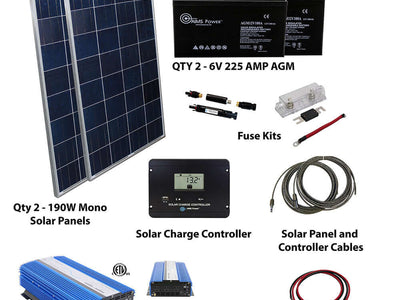
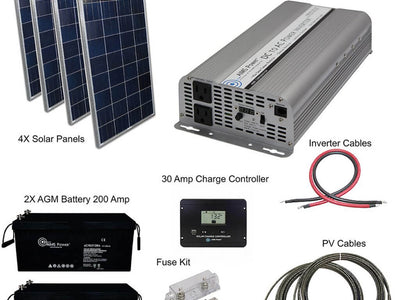
The AIMS 380-watt solar kit is where most first-time buyers start. It's a cabin and weekend retreat kit -- lights, fridge, device charging, and a few small appliances. The 1,500W pure sine inverter handles most household loads without issue. At $1,641, it's a realistic starting point for testing off-grid life before committing to a larger system.

Aims Power 380W Solar 1500W Pure Sine Inverter Kit Off Grid Complete
$1,641.00
Shop NowBest All-In-One Upgrade: AIMS Power 1980W Complete Kit
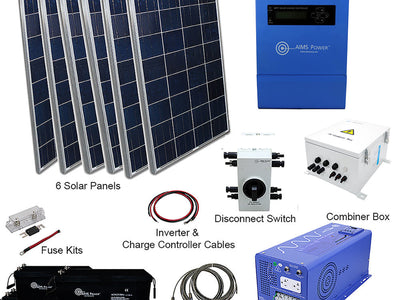
The AIMS 1980W 48V kit is built for serious off-grid use. Six high-efficiency rigid solar panels, an MPPT charge controller, and a 2,000W pure sine inverter-charger give you a complete 48V system ready for a cabin, remote home, or as a primary generator replacement. The 48V architecture means lower current, thinner cables, and room to expand the battery bank as your needs grow [4].
This is the kit we recommend when someone asks "what do I need to fully power my cabin?" It handles a full-size fridge, heat pump, power tools, and all lighting without compromise.

AIMS Power 1980W Complete Solar Kit 2000W Pure Sine Inverter 48V
$5,970.00
Shop Now
Best App-Controlled System: EcoFlow 5kVA Power Kit
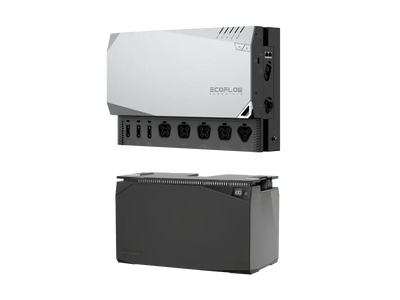
EcoFlow built the 5kVA Power Kit for people who want app control over their whole system. It pairs a 5,000VA inverter (4,000W continuous, 8,000W surge) with modular LFP batteries you manage from your phone. The 48V design lets you scale storage from 5kWh up to 45kWh as your needs grow. At $7,498, expansion stays plug-and-play and real-time monitoring is built in.

EcoFlow 5kVA 48V Power Kit - 45kWh Off-Grid Solar System
$7,498.00
Shop NowBest Premium Cabin Kit: Rich Solar 1000W 48V Cabin Kit
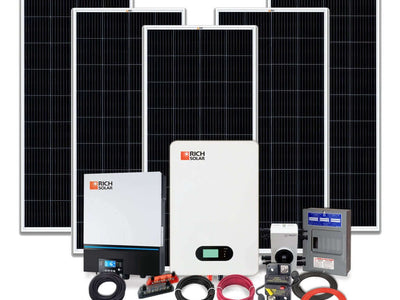
The Rich Solar 1000W Cabin Kit is a complete off-grid package for a small home or cabin. It ships with five 200W monocrystalline panels, a 5kWh 48V lithium battery, and a 6,500W 48V hybrid inverter that outputs 120VAC. The kit includes the combiner box, breakers, and cables, so every part arrives in one box. At $7,999.99, it is the turnkey pick for buyers who want a full 48V system ready to install.

What to Check Before Buying Any Kit
Every component in the kit should be rated to work with the others. Panel voltage should match the charge controller's input range. Battery voltage should match the inverter's DC input. Charge current should be appropriate for the battery bank size. Look for UL-listed inverters, IEC 61215 certified panels, and UL 1973 certified batteries. For pure sine wave inverters to pair with any battery bank, see our pure sine wave inverter collection.
System Voltage: 12V, 24V, or 48V?
| Voltage | Best For | Pros | Cons |
|---|---|---|---|
| 12V | Small RV, boat, tiny cabin | Simple, compatible with 12V appliances | High current = thick cables, limited to ~2kW |
| 24V | Medium cabin, large RV | Good middle ground | Less common than 12V or 48V |
| 48V | Homes, large cabins, serious setups | Lower current = thinner cables, more efficient, expandable | Requires 48V-compatible components throughout |
For anything over 2,000W, go 48V. The efficiency gains and wiring cost savings pay for themselves immediately.
How Do You Install an Off-Grid Solar System?
Installation complexity ranges from a weekend project to hiring a professional, depending on system size and your comfort with electrical work.
DIY-Friendly Systems (Under 3kW)
Small cabin kits and RV systems are designed for self-installation. Most come with pre-wired components, MC4 connectors for panels, and clear wiring diagrams. If you can follow instructions and use basic tools, you can install a 1,000W cabin kit in a day.
Basic steps: mount panels, run cables to charge controller, connect to battery bank, connect battery to inverter, wire inverter to your panel or outlets, configure charge controller settings, test and commission.
Professional Installation Recommended (5kW+)
Larger systems involve higher voltages, more complex wiring, permit requirements, and structural considerations. A qualified solar installer ensures proper grounding, code-compliant wiring, structural integrity of mounting systems, and correct system commissioning. Budget $2,000 to $8,000 for installation labor at this scale.
Key Installation Considerations
Panel orientation: South-facing (in the Northern Hemisphere) at a tilt angle roughly equal to your latitude maximizes annual production. Adjustable tilt mounts let you optimize seasonally.
Shading: Even partial shade on one panel can dramatically reduce output for an entire string. Use a solar pathfinder or app to map shade patterns throughout the year before installation.
Cable sizing: Undersized cables create voltage drop, heat, and energy loss. Follow manufacturer recommendations or use a voltage drop calculator. For long runs between panels and charge controller, larger gauge wire pays for itself in recovered energy.
What About Hybrid Approaches?
Pure off-grid isn't the only path. Several hybrid strategies offer flexibility.
Solar + Generator Backup: For locations with extended cloudy periods or winter production drops, a small generator provides insurance. Many hybrid inverters accept generator power to charge batteries when solar falls short. This keeps your battery bank healthy during the worst weather weeks without oversizing your solar array for worst-case scenarios.
Wind-Solar Hybrid: In locations with consistent wind patterns, adding a small wind turbine can increase reliability by 12-25%. Wind often produces power at night and during storms when solar output drops. Analysts predict hybrid solar-wind systems will increase overall efficiency by 25% for remote installations in 2026 [5].
Grid-Tied with Battery Backup: If you have grid access but want resilience, a grid-tied system with battery backup offsets utility bills during normal operation and provides stored power when the grid fails. For whole-home battery backup solutions, the BLUETTI EP900 + B500 system offers 9kW of power with expandable LiFePO4 storage.

What Are the Most Common Off-Grid Solar Mistakes?
After helping hundreds of customers build off-grid systems, we see the same errors come up again and again.
1. Undersizing the battery bank. People buy enough panels but skimp on storage. They end up with excess solar production during the day and not enough power at night. Batteries are expensive -- but they're the backbone of your system.
2. Ignoring surge requirements. A 3,000W inverter doesn't mean you can start a well pump that surges to 4,500W on startup. Always account for motor startup loads when sizing your inverter.
3. Forgetting about winter. If you size your system for July production, you'll be short in December. Design for your worst production month, or plan for a generator supplement during deep winter.
4. Cheap charge controllers. A PWM controller on a 2kW+ system wastes 20-30% of your panel investment every day. An MPPT controller pays for itself within months through recovered energy.
5. No monitoring. Without visibility into production, consumption, and battery state of charge, you're flying blind. Modern charge controllers and inverters with Bluetooth or Wi-Fi monitoring let you catch issues before they become problems.
6. Undersized wire gauge. Voltage drop from undersized cables is invisible energy loss. It doesn't break anything dramatically -- it just quietly steals 5-15% of your production indefinitely.
Is an Off-Grid Solar System Worth It in 2026?
The math has never been better. Panel prices continue to drop as U.S. developers plan to add a record 43.4 GW of utility-scale solar in 2026, driving supply chain benefits that reduce component costs across the board. LiFePO4 battery prices have fallen roughly 40% since 2022 [3].
It makes clear financial sense if you're paying $15,000+ for a utility line extension, your electricity costs exceed $0.20/kWh, your electricity costs exceed $0.20/kWh, or you qualify for the 30% federal Residential Clean Energy Tax Credit [2]. The residential sector already represents 52.9% of off-grid solar installations globally. People are choosing this path because it works. For a complete look at available systems, browse our off-grid solar power collection.
Think of it this way: a $15,000 off-grid solar system that eliminates a utility line extension and replaces $200/month in electricity costs pays back in under 6 years -- and keeps producing power for 25+ years after that. A gas generator costs less upfront but never stops costing you on fuel and maintenance. Off-grid solar is a one-time investment in permanent electricity.
The Bottom Line
An off-grid solar system isn't a science experiment or a survivalist fantasy. It's a practical, proven approach to controlling your power that hundreds of thousands of homeowners, RV owners, and remote property owners rely on every day in 2026.
The technology is mature. The costs are reasonable. The components are reliable. What it takes is honest assessment of your needs, thoughtful system design, and quality components that won't let you down when it matters most. Power that shows up when it counts doesn't require a utility bill or luck that infrastructure holds together.
Your Next Steps
- Calculate your daily energy consumption using the load table and sizing calculator above.
- Determine your location's peak sun hours using the NREL PVWatts Calculator (free at pvwatts.nrel.gov).
- Decide your system voltage and autonomy days based on your property type and climate. 48V with 2-3 days of autonomy covers most situations.
- Choose a kit at your target size. Start with our off-grid solar collection and filter by system size.
- Plan your installation approach. Under 3kW? Likely DIY-able. Over 5kW? Budget for professional installation.
- Check your 30% federal tax credit eligibility before purchasing -- it applies to off-grid installations on primary and secondary residences [2].
- Start with what you need now, design for what you'll need later. Choose 48V architecture so your system can grow.
Frequently Asked Questions
References
- Solar Energy Industries Association (SEIA), U.S. Solar Market Insight 2026 Outlook, seia.org
- U.S. Department of Energy, Residential Clean Energy Tax Credit, energy.gov/eere/solar/homeowners-guide-federal-tax-credit-solar-photovoltaics
- BloombergNEF, Battery Price Survey 2024-2025: LiFePO4 Cost Trajectory, bnef.com
- NREL, Photovoltaic System Design Best Practices, nrel.gov/solar
- Wood Mackenzie, Hybrid Renewable Energy Systems: Global Efficiency Forecast 2026, woodmac.com